• 首頁 (Home)
  • 理論介紹 (Theories)
    • 警戒色
    • 貝氏擬態 (Batesian mimicry)
    • 穆氏擬態 (Mullerian mimicry)
    • 副貝氏擬態 (quasi-Batesian mimicry)
  • 研究團隊 (research teams)
    • Candy Rowe
    • James Mallet
    • John skelhorn
  • 文獻蒐集 (Bibliography)
    • 2010-
      • 2016
      • 2015
      • 2014
      • 2013
      • 2012
      • 2011
      • 2010
    • 2000-2009
      • 2009
      • 2008
      • 2007
      • 2006
      • 2005
      • 2004
      • 2003
      • 2002
      • 2001
      • 2000
    • More than 650 references on mimicry

擬態生物學

警戒色與擬態的介紹團隊,學術文章導讀,歷史背景,物種,與生物多樣性

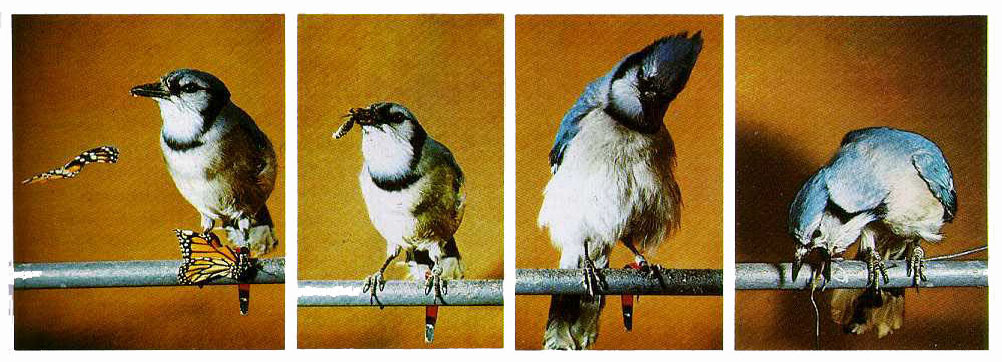
photo: Ornithology


標題:Increased predation of nutrient-enriched aposematic prey.

摘要

Avian predators readily learn to associate the warning coloration of aposematic prey with the toxic effects of ingesting them, but they do not necessarily exclude aposematic prey from their diets. By eating aposematic prey ‘educated’ predators are thought to be trading-off the benefits of gaining nutrients with the costs of eating toxins. However, while we know that the toxin content of aposematic prey affects the foraging decisions made by avian predators, the extent to which the nutritional content of toxic prey affects predators’ decisions to eat them remains to be tested. Here,we show that European starlings (Sturnus vulgaris) increase their intake of a toxic prey type when the nutritional content is artificially increased, and decrease their intake when nutritional enrichment is ceased. This clearly demonstrates that birds can detect the nutritional content of toxic prey by post-ingestive feedback, and use this information in their foraging decisions, raising new perspectives on the evolution of prey defences. Nutritional differences between individuals could result in equally toxic prey being unequally predated, and might explain why some species undergo ontogenetic shifts in defence strategies. Furthermore, the nutritional value of prey will likely have a significant impact on the evolutionary dynamics of mimicry systems.

面對有警戒性的物種時,行為理論預測捕食者會基於經驗或是恐新(neophobia),避免攝取這樣的物種,警戒色因此在演化上有機會越來越明顯,越來越有優勢。然而事情永遠不會這麼簡單,一來是我們永遠也不會知道鳥或蜥蜴在想什麼,二來是野外觀察者總是發現某些有毒的蝴蝶被吃掉。以個人經驗來說,就看過綠繡眼攻擊青斑蝶,也有其他觀察者看過白頭翁吃紫斑蝶。

這些東西明明就很不好吃,是捕食者蠢嗎?笨嗎?瞎嗎?或者是,捕食者實際上可以接受有點不好吃的獵物?

歐洲椋鳥 (Sturnus vulgaris)
photo: European Startling (wiki)

麵包蟲 (Tenebrio molitor)
photo from mealwormcare.org

基於這個想法,作者群就想知道到底捕食者在冒著難以消化的風險與獲得營養的利益間如何取捨,利用歐洲椋鳥(Sturnus vulgaris)與人工調製的餌劑,以行為實驗的設計來瞭解捕食者的取捨。作者的人工餌劑調製為無防禦(0.04ml的水),低營養+防禦(0.02ml 4% 奎寧+0.02ml 水)與高營養+防禦 (0.02ml 4% 奎寧+0.02ml 營養補充劑),將其液體打進麵包蟲(mealworm)中,透過實驗動物的適應與訓練,讓牠們攻擊麵包蟲,實驗進行15次,分為無防禦與有營養獵物兩組,營養組的15次的次序分別是高營養(1-5)、低營養(6-10)、高營養(11-15),如此能得到攻擊次數與學習曲線,分析後就知道捕食者是否能夠分辨不同營養的獵物。

Fig. 1  本實驗中被吃掉的數量與測試序列。三角形為無防禦的獵物,方塊是有防禦的獵物,1-5與11-15是高營養,6-10是低營養

Fig. 2 高/低營養的獵物被吃掉的數量比較

結果顯示,捕食者面對沒有防禦機制的獵物時,完全可以接受這樣的獵物;面對有防禦機制的獵物時,攻擊次數明顯的比沒防禦的低,然而關鍵在這,在有防禦的測試中,前五次高營養(1-5)的攻擊次數比起低營養(6-10)的次數高,之後在第11-15次的高營養測試中,又回到與1-5次的學習曲線相似,這顯示捕食者是能夠迅速的評估個體的營養程度,並且做出要不要進食不容易消化個體的判斷。

這個研究只驗證一個簡單的概念,就是捕食者到底會不會主動去吃難吃但營養的食物,就像人會不會主動去吃苦瓜一樣。結果告訴我們的確有可能有這樣的情況發生,也可能讓我們對警戒色的演化產生新的觀點,但不是說這樣就解釋一切了。譬如說,實驗中的椋鳥是透過試誤的方式來學習,也就是非得要嘗試第一次不可,意思就是實際上來說,如果第一次就吃到很毒的獵物,非得要狠狠烙個一次賽,或是病個幾天,才能進行下一次評估嗎?這麼強烈的經驗還會有下次攻擊的考量嗎?(吃到一家雷店,還會考慮去第二次嗎?)也有可能就喪命,把這種個體(笨?)篩選掉。或者是鳥類有什麼辦法能直接透過視覺來評估好不好吃呢?

還有太多的問題存在其中,但這個研究無啻又掀起一些有爭議的觀點,讓我們有更多的方向討論警戒色與防禦機制與捕食者間的關係。
Wrote by Chia-Hsuan Wei
photo from BugGuide
標題:The evolution of Batesian mimicry within the North American Asidini (Coleoptera: Tenebrionidae).

摘要

The asidine darkling beetles (Coleoptera: Tenebrionidae: Asidini) are a diverse tribe of flightless tenebrionids found in many arid and sub-arid habitats around the world. The 263 currently described North American species are contained in ten genera, all of which are restricted to the western half of the continent. The Asidini, like all members of the subfamily Pimeliinae, lack defensive glands. Instead, several phenotypic traits occur within the tribe that may help limit predation. These include the contrasting defensive strategies of crypsis, through either background matching or pattern disruption, and Batesian mimicry of the chemically defended genus Eleodes. Dorsal elytral morphology was assessed between 53 North American asidine species and 13 common Eleodes model species using multiple methodologies to assess similarities between species in the two groups that might indicate mimetic relationships. A phylogeny of the North American asidines is used to map the occurrence of differing defensive strategies within the tribe. Crypsis is reconstructed as the ancestral state, with two origins for Batesian mimicry and multiple reversals. The combination of strongly to weakly cryptic species and varying levels of mimetic fidelity to Eleodes model species make the asidines a promising lineage upon which to further explore the evolution of defensive phenotypes.
八種顯示隱蔽色的Pelecyphorus spp
photo from Fig. 1
這個研究所說的是北美的一個擬步行蟲科(Tenebrionidae)其下的一個族 Asidini (漠甲亞科,Pimeliinae)的貝氏擬態斑紋的演化,若要瞭解這個文章,要先配合另一篇文章,Phylogenetic revision of the North American Asidini (Coleoptera: Tenebrionidae)來看。這個族共包含263種,所有的種類都缺乏防禦腺體(可能是不會臭),整個族都棲息在乾燥的環境(可能是沙漠或周遭),大部分的種類都看起來像沙子的顏色,但有幾個種看起來像另一類的擬步行蟲 Eleodes spp.,因此作者對於這些看起來擬態的斑紋的演化趨勢有興趣。整體的架構是這樣,作者先發表了整個族的系統發生學,然後才有這篇討論斑紋演化的文章。

photo from Fig. 2
中間、正下方、左下為擬態者Stenomorpha spp.
其餘為擬態模型Eleodes spp.
研究中使用了11個背方的特徵,這些特徵看起來跟Eleodes spp.的擬態是有關聯的,如果是這樣的話,那把這兩類的物種同時放在一個分析矩陣下跑樹的話,兩者應該會跑在一起,而且有可能可以找出哪些特徵讓兩者看起來這麼像。另一方面作者使用這個族的樹,把擬態的特徵映象至樹上,追溯這些斑紋在樹上的變化,就能瞭解演化趨勢。

結果發現支持這兩類看起來想似的主要特徵是「背面不反光」與「顏色斑紋單一」,而整體的演化趨勢來看的話,如同大部分其他的例子,隱蔽色是祖徵,可能與Eleodes spp.的擬態特徵是複數起源。

雖然說擬態起來的相似度還是要從整體的行為斑紋來看,但分別把特徵拆開追溯其演化趨勢,有助於讓我們了解究竟相似度從何而來,也可以為未來更細膩的研究打下基礎。
Wrote by Chia-Hsuan Wei
photo from content


標題:Multi-trait mimicry and the relative salience of individual traits

摘要

Mimicry occurs when one species gains protection from predators by resembling an unprofitable model species. The degree of mimic–model similarity is variable in nature and is closely related to the number of traits that the mimic shares with its model. Here, we experimentally test the hypothesis that the relative salience of traits, as perceived by a predator, is an important determinant of the degree of mimic–model similarity required for successful mimicry. We manipulated the relative salience of the traits of a two-trait artificial model prey, and subsequently tested the survival of mimics of the different traits. The unrewarded model prey had two colour traits, black and blue, and the rewarded prey had two combinations of green, brown and grey shades. Blue tits were used as predators. We found that the birds perceived the black and blue traits to be similarly salient in one treatment, and mimic–model similarity in both traits was then required for high mimic success. In a second treatment, the blue trait was the most salient trait, and mimic–model similarity in this trait alone achieved high success. Our results thus support the idea that similar salience of model traits can explain the occurrence of multi-trait mimicry.

photo from The Haunted Pen
警戒性的物種身上通常會有不只一個顏色,而是透過複合式的顏色組合成某種「樣式」,形成強烈的對比色,這個樣式會讓捕食者產生警醒的認知,避免捕食這類的獵物。可是若扯到兩個物種間的擬態就比較複雜了,因為警戒性的物種若成為model,可是身上的顏色不只一種,那麼有作用的是哪個部分,而mimic只會演化出有用的又明顯的那個部分嗎?或是必須拷貝整體的「樣式」才有用呢?

這個研究利用人工的模型,與藍山雀做為捕食者討論這個問題。作者設定的警戒色是「藍+黑」,選擇藍色是為了避免藍山雀因為以前的經驗影響實驗結果。實驗設計如上圖,主要分為兩個部分,一個測試整體認知,一個測試顏色突出認知,其中設計以藍色是最為明顯的顏色,兩個部分都有1對1與1對多的設計。第一個結果顯示mimic的對比度與「藍+黑」最接近的最為成功,第二個結果顯示對比度與藍色最接近的最成功。這證據支持mimic的顏色突出度必須與model接近才有可能降低天擇的選汰。

如果這樣就有趣了,意思就是mimic的斑紋演化上來說,無法先變出A部分再變出B部分,看起來是必須整體同時出現,也就是題目所說的「複合式」斑紋。那麼如果不是像毒蝶那樣可以透過基因滲透傳遞性狀的族群,要如何一次性的出現相似的斑紋呢?這個研究的結果是不是比較支持「兩步演化」理論(two-step theory)呢?
Wrote by Chia-Hsuan Wei


photo from robin (wiki)

photo from blackcap (wiki)

photo from black redstrat (wiki)

標題:Five species of passerine bird differ in their ability to detect Batesian mimics

摘要

Multiple predators affect the evolution of aposematic signals in nature and these predators may substantially differ in terms of ecological and cognitive parameters. However, most experimental studies testing the evolution of Batesian mimics use only a single species of predator (usually the great tit or a domestic chick). Therefore, in the present study, we experimentally tested the responses of five passerine predators to an artificially made Batesian mimic (a cockroach equipped with the warning pattern of the red firebug) with respect to their dietary ecology. Half of the individuals of each species were fed on unmodified roaches before the experiment, whereas the other half were fed with mealworms and thus had no previous experience with roaches. We found that Batesian mimics were better protected than inconspicuous prey against inexperienced great tits and robins alone. The other three bird species showed high level of neophobia; therefore, the effect of warning coloration could not be assessed. We also found that experienced birds attacked a greater number of Batesian mimics compared to inexperienced individuals of all tested species, with the exception of blackcaps. In the great tits, robins, and blue tits, a significant number of experienced birds attacked the Batesian mimic, which was possibly the result of a learned search image for a roach. Our results suggest that using a limited array of predators to describe evolutionary processes forming the diversity of antipredatory strategies of the prey may be biased and need not describe the situation occurring in nature.

大部分用行為學的方式討論擬態與警戒色的功能性與演化的時候,通常這些作者選的是特定的幾種鳥類,最常見的就是家雞或是大山雀,但是在自然環境中,能夠推動這些斑紋演化的捕食者可不只一種,只用少數幾種「模式物種」真的能正確的反應實際的演化歷程嗎?還是有偏差的結果呢?

這個研究就在探討五種燕雀類對於擬態斑紋的選擇行為,其實就是探索其他可能選汰演化的捕食者,或是其他可用來放在行為實驗中作為捕食者的可能性。作者選擇五種燕雀鳥類,分別是大山雀(great tit)、藍山雀(blue tit)、知更鳥 (robin)、赭紅尾鴝 (black redstart)與黑頭鶯 (blackcap),讓牠們去選擇椿象(firebug)與蟑螂,看牠們對於貝氏擬態的mimic是否會避忌。

結果顯示大山雀與知更鳥分的出來擬態的椿象,而且會減少捕食牠們,其他三種則有恐新症(neophobia,傾向不去嘗試新的事物的行為),因此無法得知接下來是否會有避忌行為。大山雀、知更鳥與藍山雀的有經驗的個體不只分的出來貝氏擬態的椿象,而且知道可以吃。

這個實驗就是一個前導性的研究,就是在測試到底還有什麼鳥是能用在測試這種行為實驗,也某種程度上告訴我們,不同種的行為差異很大,甚至同種的捕食者不同族群行為也有差異(見這篇),所以一直用同種,或是同族群的捕食者究竟能解釋多少型塑擬態的機制,或是應該採用很多種不同的捕食者來探討背後的理論,都是未來可以繼續討論的方向。

Wrote by Chia-Hsuan Wei


原文標題:Evidence of signaling benefits to contrasting internal color boundaries in warning coloration

[摘要][原文網址]
It has been suggested that the common existence of regular patterning in aposematic prey animals makes them “stand out” from the background, improving detection and recognition. Another suggestion is that internal patterns could have a similar positive effect on predator aversion learning as prey-to-background contrast. We used wild caught blue tits (Cyanistes caeruleus) and artificial prey signals to investigate if internal color boundaries, pattern regularity and pattern symmetry affect learning. Birds in different treatments were trained, on a complex background, to discriminate between artificial prey with different nonrewarding color stimuli with a black pattern and rewarding stimuli without a black pattern, followed by a generalization test. This study provides evidence of learning benefits to internally contrasting patterns as the striped prey stimuli were learned faster than the unstriped. Also, we found no beneficial effects of pattern regularity and symmetry. The birds generalized more between prey with different black patterns than to the profitable prey, suggesting that color is of foremost importance. The generalization test also showed a greater avoidance of striped than that of unstriped prey, suggesting some attention on patterns. Thus, internal patterning may affect signal salience and in some circumstances benefit prey due to both a faster avoidance learning and generalization behavior.


簡單說明一下這篇文章大概在幹嘛,警戒色這東西就比較大眾化的了解,不外乎就是顏色很鮮豔,也就是跟背景對比明顯,容易被捕食者發現,捕食者知道這東西不能吃這樣,可是我們可以發現自然界中並不是每種有警戒斑紋的東西長得都一樣,有的條紋一樣顏色不一樣,有的顏色一樣花紋不一樣,有的對稱有的不對稱,那麼怎樣的組合才是能有最大效益的,就是這篇文章討論的重點,而其實這篇文章的作者Gabriella Gamberale-Stille有一系列的文章在討論這個問題,容我未來慢慢介紹。


這篇文章實驗方式就是用野外抓來的藍山雀(blue tits),經由訓練吃食人工餌料後用來作實驗,而人工餌料的設計是這樣的


基本上是分為底色與斑紋組合兩件事,分別測試後了解捕食者對於這些顏色斑紋的反應。

作實驗的地方像這樣


主要結果是(1)有線條的比沒線條的有用,但線條是否規律無影響(這個是有點奇怪);(2)在概括性認知實驗的結果中,無論是哪種處理,都能辨識出獵物是否能吃;(3)顏色 在辨認上似乎是優先於斑紋的排列。
Wrote by Chia-Hsuan Wei
Older Posts Home

FB專頁

熱門文章

  • [科普]自然界中的詐騙集團:生物間「擬態」現象的奧祕
  • [Review] 警戒色與擬態的多樣性之演化:關於多態型、移動平衡與種化
  • 捕食者對視覺訊號的差異的內在排序與其對擬態演化的影響

精選文章

貓頭鷹蝶的眼紋真的擬態貓頭鷹的眼睛嗎?

相關網站

  • Heliconius Homepage
    Richard ffrench-Constant, Heliconius Genome Consortium Pioneer Richard ffrench-Constant was a key member of the original Heliconius Genome Consortium which...
  • 這是什麼啊? 可以吃嗎?
    最近出現一個被狂轉的新聞,大意是說有人為了避免蝸牛被路殺所以在其殼上彩繪,希望這樣就能讓人類注意到蝸牛的存在而不要把牠們踩死。這聽起來好像立意不錯喔? 但就我們研究警戒與擬態的角度來說,我們認為這種作法天真且有些荒謬,為什麼呢? - 在偽裝(camouflage)與警戒(aposematism)形成...
  • WELCOME TO THE BIODIVERSITY LAB! | Biodiversity Lab
  • Kronforst Lab at the University of Chicago
  • mallet lab
  • MimeticButterflies
  • Mathieu Joron - Home
  • Evolution of predator-prey interactions — Bio- ja ympäristötieteiden laitos

文章類型

  • 文章 (Article) 113
  • 擬態環 (mimicry ring) 12
  • 回顧 (review) 10
  • 科普 4
  • 擬態那些事 3
  • 書 (Book) 3
  • 評論 (comment) 1

研究領域

  • 貝氏擬態 (Batesian mimicry) (43)
  • 警戒性 (Aposematism) (40)
  • 穆氏擬態 (Müllerian mimicry) (37)
  • 多態型 (polymorphism) (16)
  • 擬態環 (mimicry ring) (12)
  • 侵略型擬態 (aggressive mimicry) (10)
  • 隱蔽性 (crypsis) (10)
  • 不完美擬態 (imperfect mimicry) (6)
  • 種化 (speciation) (5)
  • 雌性擬態 (female-limited mimicry) (5)
  • 性擇 (sexual selection) (4)
  • 鳥蛋寄生 (egg parasite) (4)
  • 眼斑 (eyespot) (3)
  • 假頭 (false head) (2)
  • 性雙型性 (sexual dimorphism) (2)
  • 擬蟻性 (Myrmecomorphomania) (2)
  • 機動性擬態 (locomotory mimicry) (2)
  • "模糊"型擬態 (satyric mimicry) (1)

研究方式

  • 行為學 (Ethology) (46)
  • 生態 (Ecology) (21)
  • 系統發生學 (phylogenetics) (16)
  • 基因體 (Genomics) (12)
  • 視覺模型 (visual model) (10)
  • 模擬(modelling and simulation) (6)
  • 遺傳學 (genetics) (6)
  • 族群遺傳 (population genetics) (5)
  • 分子生物學 (Molecular biology) (4)
  • 化學生態 (Chemical ecology) (3)
  • 分子鑑定 (molecular identificaiton) (1)
  • 古生物學 (palaeontology) (1)
  • 地理資訊系統 (GIS) (1)
  • 演化發育學 (Evo-Devo) (1)

分類群

Copyright © 2015 擬態生物學. Designed by OddThemes | Distributed By Gooyaabi Templates