• 首頁 (Home)
  • 理論介紹 (Theories)
    • 警戒色
    • 貝氏擬態 (Batesian mimicry)
    • 穆氏擬態 (Mullerian mimicry)
    • 副貝氏擬態 (quasi-Batesian mimicry)
  • 研究團隊 (research teams)
    • Candy Rowe
    • James Mallet
    • John skelhorn
  • 文獻蒐集 (Bibliography)
    • 2010-
      • 2016
      • 2015
      • 2014
      • 2013
      • 2012
      • 2011
      • 2010
    • 2000-2009
      • 2009
      • 2008
      • 2007
      • 2006
      • 2005
      • 2004
      • 2003
      • 2002
      • 2001
      • 2000
    • More than 650 references on mimicry

擬態生物學

警戒色與擬態的介紹團隊,學術文章導讀,歷史背景,物種,與生物多樣性

photo: what-when-how.com


標題:The effect of dominance on polymorphism in Müllerian mimicry

摘要

Dominance controls the phenotype of heterozygous individuals, and plays an important role in the maintenance of polymorphism. Here we focus on the dominance acting on warning-pattern polymorphism in species engaged in Müllerian mimicry. Müllerian mimics are toxic species which display bright colour patterns used as a warning signal to predators and are subject to local positive density-dependent selection. Some Müllerian mimics are polymorphic due to a selection/migration balance in spatially heterogeneous communities of prey. Since heterozygotes at a locus controlling warning pattern might exhibit intermediate, non-mimetic heterozygous morphs, dominance is likely to influence the polymorphism at this locus. Using a deterministic model describing migration, density-dependent predation and reproduction, we investigated the influence of dominance on the dynamics of alleles at locus determining mimetic phenotype. Our results suggest dominance may interact with migration and selection and plays an important role in shaping the conditions of polymorphism persistence and the frequency of alleles at this locus. Our results thus highlight the important role of dominance in the dynamics of polymorphism at loci under balancing selection due to environmental heterogeneity.

有些穆氏擬態物種多態性的產生與維持,一直是個吸引科學家的問題,雖然已經從很多個方面討論,但總很難有個結論,主要是因為要解釋斑紋的有效性與不同斑紋的族群間的平衡來自多重複雜的因素,並且因素間可能有交互作用,很不容易從一而論,解釋所有的情況。

這個研究的目的是想從遺傳學的角度著手,解釋顯性遺傳在穆氏擬態多態性的維持上的重要性。如果穆氏擬態的多態性來自不同斑紋族群遷徙時的雜交,那麼控制這個斑紋的基因座(locus)的顯隱性必然影響斑紋性狀的表現,當兩個族群雜交時就會出現中間型 (intermediate forms),又因為只有顯性的斑紋可以表現在斑紋上,演化的歷程中就可能根據這些顯性表型逐漸的影響讓基因頻率轉移,進而產生新的斑紋。

本篇所使用的數學模型的一部分
作者用數學模型討論顯性基因的演化模式,其中考慮物種的遷徙、密度為基礎的被捕食率與生殖等因素探索顯性性狀對於多態性演化產生的影響。經過一堆公式的推導與模擬後,結果顯示遷徙與擇汰對多態型的維持與斑紋基因的頻率扮演重要的角色,這個結果也同時揭示顯性遺傳在多態性的平衡上的重要性。

Fig. 2 假設一個對偶基因ab在不同的狀況下的模擬結果。
灰:多態型維持 白:a被固定 黑:b被固定
A:全隱性 B:部分隱性 C:共顯性 D:全顯性

說實在的,這真是篇讓人看完頭很痛的文章......
Wrote by Chia-Hsuan Wei
photo from content
a)表示精靈箭毒蛙 (R. imitator)
b) 表示其model 皇冠箭毒蛙 (R. fantastica) 與 齊亞曼箭毒蛙 (R. variabilis)
c) 兩型的分佈與雜交帶是意圖
d) 雜交帶出現的精靈箭毒蛙的多態型
e) 研究區域

標題:Reproductive isolation related to mimetic divergence in the poison frog Ranitomeya imitator

摘要

In a mimetic radiation—when a single species evolves to resemble different model species—mimicry can drive within-species morphological diversification, and, potentially, speciation. While mimetic radiations have occurred in a variety of taxa, their role in speciation remains poorly understood. We study the Peruvian poison frog Ranitomeya imitator, a species that has undergone a mimetic radiation into four distinct morphs. Using a combination of colour–pattern analysis, landscape genetics and mate-choice experiments, we show that a mimetic shift in R. imitator is associated with a narrow phenotypic transition zone, neutral genetic divergence and assortative mating, suggesting that divergent selection to resemble different model species has led to a breakdown in gene flow between these two populations. These results extend the effects of mimicry on speciation into a vertebrate system and characterize an early stage of speciation where reproductive isolation between mimetic morphs is incomplete but evident.

photo from content
各種不同參數的比較結果


討論擬態、種化與族群遺傳研究目前只有毒蝶 (Heliconius)比較多,精靈箭毒蛙的例子與毒蝶的例子很相似,不同區域擬態不同的物種,但對於不同族群間的遺傳結構,基因有沒有在族群間交流還不清楚。這個研究透過比較各種參數,像是微衛星體、身體的顏色與樣式、雄性的體重等等,顯示這個族群間只有很狹隘的雜交帶,各族群間已經有十分顯著的差異。這跟毒蝶的例子相似,可能是一個因為擬態的斑紋侷限族群的分佈,進而產生地理隔離種化的例子。


photo from content
此圖說明不同擬態型的精靈箭毒蛙的遺傳結構
這樣的研究與毒蝶最大的差異就在於這是脊椎動物,對於演化歷程完全不同的兩個擬態系統來說,如果能找類似的作用機制,是不是就能替擬態在自然界的作用找到個通論了呢?相似的系統還有很多,期待未來的發展。
Wrote by Chia-Hsuan Wei
(copyright: Twomey et al. 2015)

標題:Mimetic Divergence and the Speciation Continuum in the Mimic Poison Frog Ranitomeya imitator

摘要 [原文]

While divergent ecological adaptation can drive speciation, understanding the factors that facilitate or constrain this process remains a major goal in speciation research. Here, we study two mimetic transition zones in the poison frog Ranitomeya imitator, a species that has undergone a Müllerian mimetic radiation to establish four morphs in Peru. We find that mimetic morphs are strongly phenotypically differentiated, producing geographic clines with varying widths. However, distinct morphs show little neutral genetic divergence, and landscape genetic analyses implicate isolation by distance as the primary determinant of among-population genetic differentiation. Mate choice experiments suggest random mating at the transition zones, although certain allopatric populations show a preference for their own morph. We present evidence that this preference may be mediated by color pattern specifically. These results contrast with an earlier study of a third transition zone, in which a mimetic shift was associated with reproductive isolation. Overall, our results suggest that the three known mimetic transition zones in R. imitator reflect a speciation continuum, which we have characterized at the geographic, phenotypic, behavioral, and genetic levels. We discuss possible explanations for variable progress toward speciation, suggesting that multifarious selection on both mimetic color pattern and body size may be responsible for generating reproductive isolation.


簡單的說一下這個故事的來由。

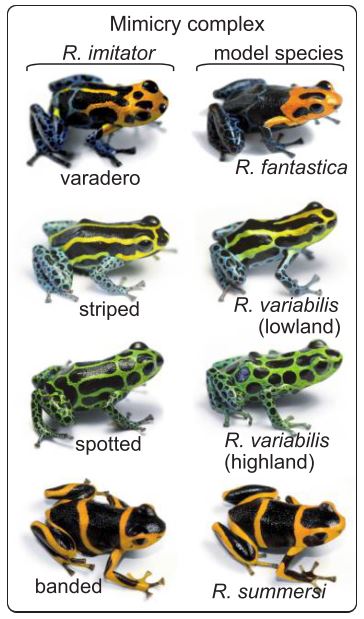
圖中左列的這個蛙蛙是個分佈在秘魯的一種箭毒蛙,中文名稱叫精靈箭毒蛙,這個蛙蛙很神奇的是個多態型,分別擬態右列四個位於不同棲地的物種,剛好這四個物種都在秘魯,而且剛好這四個物種都分佈在附近,這蛙蛙又剛好擬態這四個都在附近的物種。

這一切都這麼剛好不拿來做點什麼實在太可惜了。

所以什麼族群遺傳、野外調查、多態型分佈、雜交帶、選偶偏好之類的,想的到的可以做的其實都做了,現在的問題就在於:這樣的擬態型態分化會不會帶動種化?

於是這篇文章對於幾個不同型的雜交帶分別調查了中間型地理分佈的距離,族群是否基因交流,不同型態族群間的雄性是否有擇偶偏好等等。

在這裡我先說明,如果有種化現象的話,這些預期應該是中間型地理分佈的距離(也就是雜交帶)的空間應該很狹窄,族群間基因交流與滲漏的數值很低,雄性應該偏好選擇與自己相似的雌性,如此才有可能帶動種化。

結果說明中間型的地理分佈不一,從幾十公里到一百公里都有;族群間的基因交流值非常高;在雜交帶的雄性沒有偏好,可是在某些型態分佈中心的雄性有顯著的偏好。

結論上來說就是該有的都沒有,但這文章就抓了這點「在雜交帶的雄性沒有偏好,可是在某些型態分佈中心的雄性有顯著的偏好」來說明這是強烈的證據支持這族群正在連續性種化(speciation continuum)的開端,整篇文章唯一正面的證據就只有這個,其他大部分都只部分支持或看不出來族群間有明顯的分化,而且全文脈絡感覺就是為了要解釋這個現象而寫的,儘管只有一小部分的證據支持這現象。

所以各位同學看到了嗎,就算你的樹都沒解析度,族群都沒分化,但只要符合某些假設,你也可以說這就是種化的開端喔!

至於連續性種話這說下去太複雜了,有需求的話再看看要不要寫一篇來解釋一下。


Wrote by Chia-Hsuan Wei
原文標題:Cryptic genetic and wing pattern diversity in a mimetic Heliconius butterfly

摘要 [原文網址]

Despite rampant colour pattern diversity in South America, Heliconius erato exhibits a ‘postman’ wing pattern throughout most of Central America. We examined genetic variation across the range of H. erato, including dense sampling in Central America, and discovered a deep genetic break, centred on the mountain range that runs through Costa Rica. This break is characterized by a novel mitochondrial lineage, which is nearly fixed in northern Central America, that branches basal to all previously described mitochondrial diversity in the species. Strong genetic differentiation also appears in Z-linked and autosomal markers, and it is further associated with a distinct, but subtle, shift in wing pattern phenotype. Comparison of clines in wing phenotype, mtDNA and nuclear markers indicate they are all centred on the mountains dividing Costa Rica, but that cline width differs among data sets. Phylogeographical analyses, accounting for this new diversity, rewrite our understanding of mimicry evolution in this system. For instance, these results suggest that H. erato originated west of the Andes, perhaps in Central America, and as many as 1 million years before its co-mimic, H. melpomene. Overall our data indicate that neutral genetic markers and colour pattern loci are congruent and converge on the same hypothesis—H. erato originated in northwest South America or Central America with a ‘postman’ phenotype and then radiated into the wealth of colour patterns present today.

毒蝶的故事太複雜,之後再來整理,先總結一下這篇的結論。(本篇請搭配中南美洲地圖服用)

這篇也是利用族群遺傳的方法討論Heliconius erato的分化,用了好幾個分子標記(詳情請自行參閱本文)與十分密集的取樣,即使如此仍發現H. erato在哥斯大黎加的山區兩側的族群有遺傳分化。而這個種根據本文的分析則顯示可能起源於哥斯大黎加(中美洲起源,與之前的假說是從南美洲的安地斯山起源不同),而起源的時間則比其co-mimics Heliconius melpomene早了一百萬年。如果這個假說成立,則最早的斑紋是一個叫做postman樣式的斑紋,從中美洲起源後 擴散至南美洲。

ps. 種起源與斑紋的起源可能不同啊......
Wrote by Chia-Hsuan Wei

原文標題:Advergence in Müllerian mimicry: the case of the poison dart frogs of Northern Peru revisited

摘要 [原文連結]

Whether the evolution of similar aposematic signals in different unpalatable species (i.e. Müllerian mimicry) is because of phenotypic convergence or advergence continues to puzzle scientists. The poison dart frog Ranitomeya imitator provides a rare example in support of the hypothesis of advergence: this species was believed to mimic numerous distinct model species because of high phenotypic variability and low genetic divergence among populations. In this study, we test the evidence in support of advergence using a population genetic framework in two localities where R. imitator is sympatric with different model species, Ranitomeya ventrimaculataand Ranitomeya variabilis. Genetic analyses revealed incomplete sorting of mitochondrial haplotypes between the two model species. These two species are also less genetically differentiated than R. imitator populations on the basis of both mitochondrial and nuclear DNA comparisons. The genetic similarity between the model species suggests that they have either diverged more recently than R. imitator populations or that they are still connected by gene flow and were misidentified as different species. An analysis of phenotypic variability indicates that the model species are as variable as R. imitator. These results do not support the hypothesis of advergence by R. imitator. Although we cannot rule out phenotypic advergence in the evolution of Müllerian mimicry, this study reopens the discussion regarding the direction of the evolution of mimicry in the R. imitator system.


箭毒蛙是一個關於警戒色很出名的例子,當然除了鮮豔的顏色外,跟南美洲原住民用箭毒蛙的神經毒抹在吹箭上也有關,而這也是中文翻譯的由來。大部分提到箭毒蛙大概都只會想到警戒色,而那些通常是只Dentrobates這個屬的類群,另一個類群就有些種類牽扯到擬態,也就是這篇文章所關注的類群,Ranitomeya,中文翻成精靈箭毒蛙,其實是一種台灣寵物市場也有在流通的寵物蛙。

R. imitator就是這篇文章的主角,這個在低地與高地的斑紋是不一樣的,在低地的種類是線條型的,被認為擬態R. ventrimaculata(上圖右邊),而高地型則是網紋型,被認為擬態R. variabilis(上圖左邊),在擬態的演化預測中,擬態群的產生通常是趨同(convergence)或是單向趨同(advergence),而R. imitator因為分布廣泛,而且到處擬態不同的箭毒蛙,看起來有明顯的區域性,被認為是單向趨同的一個例子。

文中重新檢驗了這個單向趨同的假說,發現高低地的兩個model本來以為是不同種,結果發現這兩種還有基因交流,也就是應該是同一種,而且結果也顯示本來認為是model的物種分化時間居然比mimic還晚近,因此作者推論這個種不是比R. imitator還晚出現,就是分化還仍有頻繁的基因交流。

這個結果有趣的地方在於imitator其實斑紋變化非常的大,稍微搜尋一下就發現其實有很多的中間型,而ventrimaculata與variablis相對來說是區域性的穩定,因此imitator不被當成是model事情有可原;可是箭毒蛙其實是兩者都有毒,因此imitator被認為是model也無不可,且符合演化的預期,可是model,尤其是在穆氏擬態中,應該是要非常穩定的斑紋,而這與事實互相矛盾,因次需要更多的證據才能知道是怎麼回事。

Wrote by Chia-Hsuan Wei
Older Posts Home

FB專頁

熱門文章

  • [科普]自然界中的詐騙集團:生物間「擬態」現象的奧祕
  • [Review] 警戒色與擬態的多樣性之演化:關於多態型、移動平衡與種化
  • 放棄身為跳蛛的堅持:除了型態之外,蟻蛛的動作也像螞蟻嗎?

精選文章

貓頭鷹蝶的眼紋真的擬態貓頭鷹的眼睛嗎?

相關網站

  • Heliconius Homepage
    Michel Cast sent me pictures of this nice hybrid specimen from Ceara, Brazil! Thank you Michel and P. Jauffret!
  • 這是什麼啊? 可以吃嗎?
    最近出現一個被狂轉的新聞,大意是說有人為了避免蝸牛被路殺所以在其殼上彩繪,希望這樣就能讓人類注意到蝸牛的存在而不要把牠們踩死。這聽起來好像立意不錯喔? 但就我們研究警戒與擬態的角度來說,我們認為這種作法天真且有些荒謬,為什麼呢? - 在偽裝(camouflage)與警戒(aposematism)形成...
  • WELCOME TO THE BIODIVERSITY LAB! | Biodiversity Lab
  • Kronforst Lab at the University of Chicago
  • mallet lab
  • MimeticButterflies
  • Mathieu Joron - Home
  • Evolution of predator-prey interactions — Bio- ja ympäristötieteiden laitos

文章類型

  • 文章 (Article) 113
  • 擬態環 (mimicry ring) 12
  • 回顧 (review) 10
  • 科普 4
  • 擬態那些事 3
  • 書 (Book) 3
  • 評論 (comment) 1

研究領域

  • 貝氏擬態 (Batesian mimicry) (43)
  • 警戒性 (Aposematism) (40)
  • 穆氏擬態 (Müllerian mimicry) (37)
  • 多態型 (polymorphism) (16)
  • 擬態環 (mimicry ring) (12)
  • 侵略型擬態 (aggressive mimicry) (10)
  • 隱蔽性 (crypsis) (10)
  • 不完美擬態 (imperfect mimicry) (6)
  • 種化 (speciation) (5)
  • 雌性擬態 (female-limited mimicry) (5)
  • 性擇 (sexual selection) (4)
  • 鳥蛋寄生 (egg parasite) (4)
  • 眼斑 (eyespot) (3)
  • 假頭 (false head) (2)
  • 性雙型性 (sexual dimorphism) (2)
  • 擬蟻性 (Myrmecomorphomania) (2)
  • 機動性擬態 (locomotory mimicry) (2)
  • "模糊"型擬態 (satyric mimicry) (1)

研究方式

  • 行為學 (Ethology) (46)
  • 生態 (Ecology) (21)
  • 系統發生學 (phylogenetics) (16)
  • 基因體 (Genomics) (12)
  • 視覺模型 (visual model) (10)
  • 模擬(modelling and simulation) (6)
  • 遺傳學 (genetics) (6)
  • 族群遺傳 (population genetics) (5)
  • 分子生物學 (Molecular biology) (4)
  • 化學生態 (Chemical ecology) (3)
  • 分子鑑定 (molecular identificaiton) (1)
  • 古生物學 (palaeontology) (1)
  • 地理資訊系統 (GIS) (1)
  • 演化發育學 (Evo-Devo) (1)

分類群

Copyright © 2015 擬態生物學. Designed by OddThemes | Distributed By Gooyaabi Templates