• 首頁 (Home)
  • 理論介紹 (Theories)
    • 警戒色
    • 貝氏擬態 (Batesian mimicry)
    • 穆氏擬態 (Mullerian mimicry)
    • 副貝氏擬態 (quasi-Batesian mimicry)
  • 研究團隊 (research teams)
    • Candy Rowe
    • James Mallet
    • John skelhorn
  • 文獻蒐集 (Bibliography)
    • 2010-
      • 2016
      • 2015
      • 2014
      • 2013
      • 2012
      • 2011
      • 2010
    • 2000-2009
      • 2009
      • 2008
      • 2007
      • 2006
      • 2005
      • 2004
      • 2003
      • 2002
      • 2001
      • 2000
    • More than 650 references on mimicry

擬態生物學

警戒色與擬態的介紹團隊,學術文章導讀,歷史背景,物種,與生物多樣性


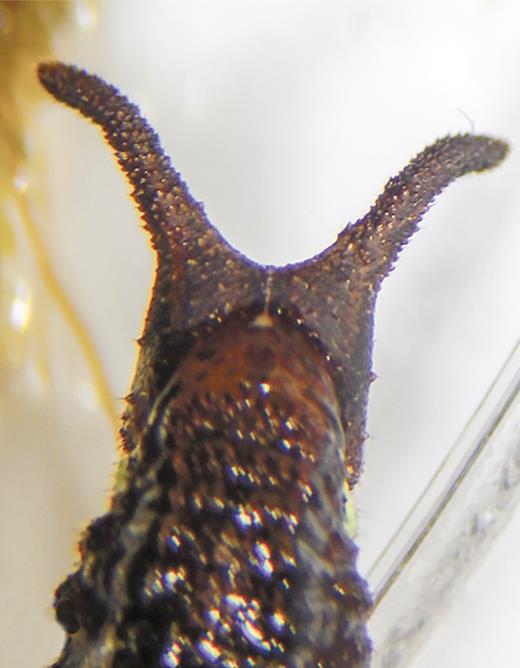
可能是擬態的鱗翅目幼蟲
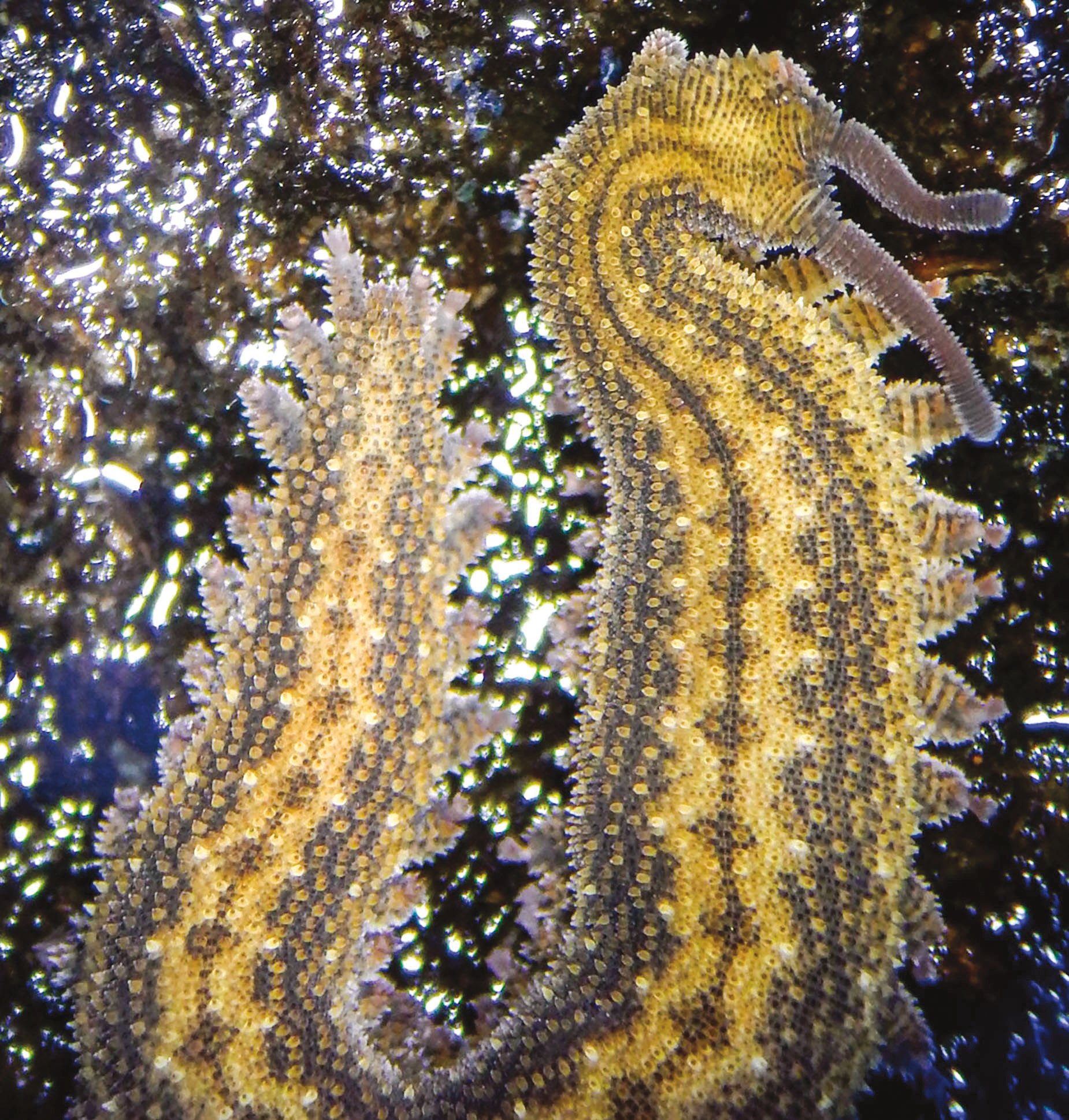
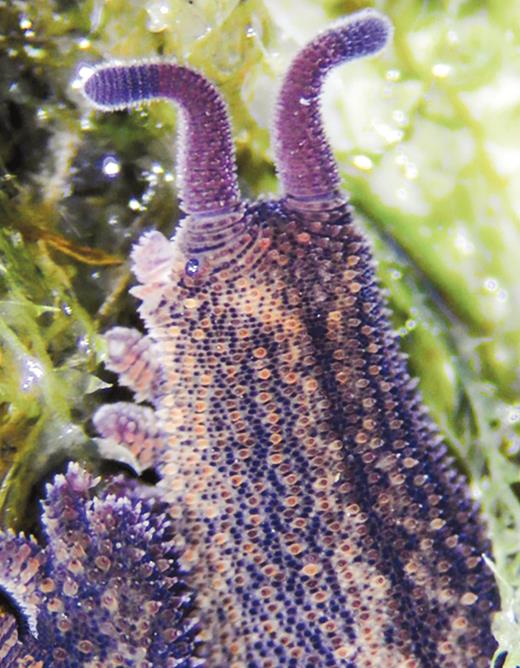
可能是模型的有爪動物

有爪動物 (Onychophora) 是個可愛又神奇的生物,有著長長的身體與很多的腳,現生已描述的種類大約200種(但相信有更多尚未發現),主要分佈在赤道與熱帶地區,根據牠已滅絕的姐妹群來看,其祖先可能早期寒武紀就已存在。

這篇文章描述的是在厄瓜多的有爪動物,而且作者認為當地某些頭上有角的鱗翅目幼蟲擬態這些有爪動物,原因是因為有爪動物在遭遇敵人時,會噴出黏液與用大顎防禦,這些作者認為是一種「讓捕食者不悅」的行為,而幼蟲沒有其它防禦機制,因此鱗翅目幼蟲獲得保護,且根據文中引用的Wagner (2005),美洲的一種鳳蝶Battus philenor的幼蟲與有爪動物的例子(是說這篇也有點問題),因此他們認為這是一種貝氏擬態的例子。

這是個很妙的觀察。兩種不相干的動物生活在同一個地方又長得像,說這是擬態好像很合理,但我們如果考量擬態與演化的前提,就會發現有些部份值得討論:
  1. 有爪動物看起來是與背景對比不強烈的顏色,這樣的體色,或是身體任何部分,有明顯到能引發捕食者警戒或有深刻印象的作用,讓捕食者產生避忌嗎? 
  2. 有爪動物與幼蟲的相對數量未知,但根據一些資料,有爪動物的數量似乎不多,這樣能讓幼蟲獲得足夠的好處嗎? 
  3. 作者認為這是貝氏擬態只是因為行為與外型相似,但他們似乎沒注意到某些沒有有爪動物的區域也有頭上有兩根角,行動緩慢的幼蟲,這個特徵難道不是從幼蟲的祖先承襲來的嗎? 

有了這些疑問,所以能說他們的觀察錯了嗎?恐怕還不行。捕食者看到了什麼,是否真的有作用是不清楚的,相對數量有多少也很難說,就算這個行為是祖徵,也難保幼蟲沒有從這樣的相似性獲得部份來自擬態的好處,因此,雖說這篇証據力薄弱,倒也還不能完全否決。

老話一句,這個現象需要更多的研究。

Zitani NM, Thorn RG, Hoyle M, Schulz JM, Steipe T, Ruiz YB, Sarquis-Adamson Y & Wishart AE. 2018. An Onychophoran and Its Putative Lepidopteran Mimic in the Arboreal Bryosphere of an Ecuadorian Cloud Forest. American Entomologist 64: 94–101.

Wrote by Chia-Hsuan Wei
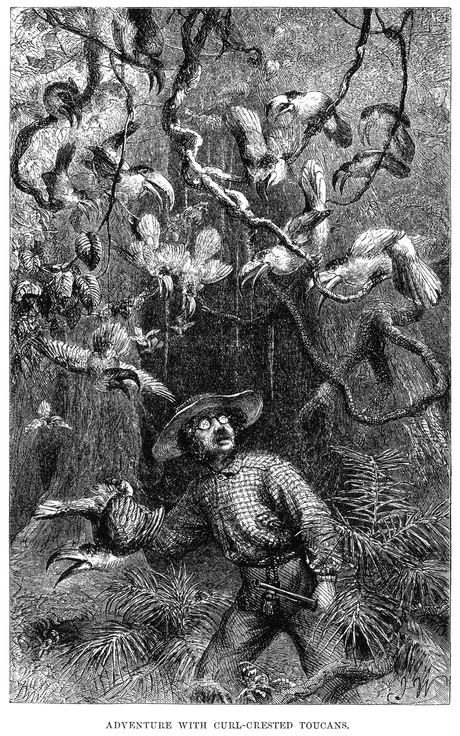
貝茲(1863)出版的遊記中插圖。


「親愛的萊士:

好久不見了,你好嗎?你在那遙遠的神秘東方看了了什麼呢?還記得當年我們踏上亞馬遜的Para土地的那一刻嗎?你踏上馬來群島時是否也像我現在一樣,想起了那一刻呢?

我剛回到倫敦,打算好好的整理這些無價的標本,還記得我們在亞馬遜的時候看到得那些很相似的蝴蝶嗎?我對這個現象有一個理論,有空想說給你聽聽,而每當我看到這些蝴蝶時,總會想到遠在馬來群島還在採集的你。

你借給我的,來自東方的神秘標本我已經收到了,好好的存放在我的標本櫃裡。你呢?何時會踏上回到倫敦的旅途呢?

誠摯的 貝」


(出自民明書房,你不知道的英國自然史學家) 
----

在中文的世界裡,最熟悉的自然史學家莫過是那個搭著小獵犬號環遊世界,在自家小花園宅個十幾年生出巨作「物種原始」,奠定生物學中最重要基礎「演化論」的查理斯。達爾文 (Charles R. Darwin),而對自然史更有一點興趣的話,會認識後來認為與達爾文在演化論的發表上有著同等重要的貢獻,而且花費了8年時間在東南亞區域採集與觀察的阿弗萊特。華萊士 (Alfred R. Wallace)。然而,在同一個年代,有個英國的自然學家,他在1862年提出的概念至今必然會在所有人的課本上提到,出現在野外志工解說員必然會舉的例子中。他一生從未來到亞洲,也未與亞洲有過任何直接的關聯,也或許是這個原因,雖有無數的外文資料介紹討論他的生平與貢獻,或是與當時科學家的來往書信,但在中文的世界中幾乎沒有完整的資料介紹他的這些生平,但他的觀察與理論提供達爾文演化論中關於天擇最佳的例子,如果沒有這個現象的支持,達爾文或許就少了點推出演化論的契機。

亨利。貝茲(Henry W. Bates, 1825-1892)—或許你對這個名字沒什麼印象,但在參與野外導覽時一定聽過他的理論—「貝氏擬態」。

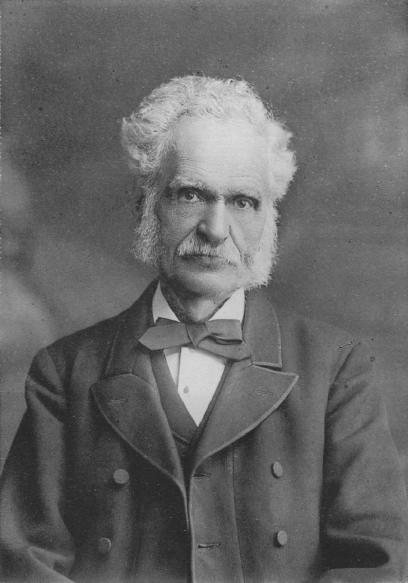
照片1892年刊載於貝茲訃聞上的照片,攝於同年,貝茲時為67歲。

貝茲先生,你是誰?

在正式進入貝氏擬態前,我想先簡單介紹一下這個自然理論的奠基者—亨利。貝茲,與他在亞馬遜那個長達11年的人生大冒險。他是個與達爾文以及華萊士同樣重要的英國自然學家,出生在英國萊斯特(Leicester)的中產階級家庭,他有著普通的教育,過著普通的生活,與普通人不同卻與大部分自然學家相同的是,他愛抓蟲,對自然現象著迷,而且有很好的觀察力,好到18歲的時候就開始寫論文(在那個年代)。在加入Mechanics' Institute後,他就開始研究在旁邊的森林(Charnwood Forest)裡的昆蟲。在大學中認識華萊士後,怎麼也想不到接他會有人生中最波瀾壯闊的旅程。

「1847年某日,貝茲22歲,華萊士24歲,中午吃飯時。

貝:啊啊,這附近的蟲我們都看過了,萊士,越來越覺得在英國抓蟲不好玩了。你有聽過一些南美的故事嗎?據說那裡有著無數的新蟲等我們去抓呢。啊啊啊,好想去啊….

華:你說得沒錯,貝。可是我們沒有錢。沒有錢就沒船票,沒法去啊!
我也好想去啊啊啊啊啊!
貝:那不然這樣,我們可以去問有沒有人想買沒看過的標本。那些假掰貴族一定有興趣,國家的博物館也一定想增加館藏。來自神秘南美亞馬遜的標本聽起來很有賣點呢!賣出的錢就能當成我們的旅費了啊! 好想去啊啊啊!

華:說得好,貝!我們的政府hen有錢!而且我正好有認識的蟲商與官員可以處理,這樣我們就有錢去南美抓蟲了!而且回來後再寫遊記出個書再賺一筆,上個報紙有知名度後再來接業配,這樣就不用煩惱了!好棒啊啊啊!貝!

貝、華:嘿嘿嘿…..(好想去啊!)」

(出自民明書房,你不知道的英國自然史學家) 

在1848年的四月,他們懷著滿肚子的壞水(x)希望(O)從利物浦出發了,前往那未知的南美叢林。在大約兩個月的航行,他們終於到了第一座城市Pará(現今巴西的貝倫),並且一同在這個區域採集。在第一年中他們就送回7000件各式各樣的生物標本,並賣出大部份的標本以支持他們的旅程(這部份是真的)。而在接下來的幾年中,他們協議分別沿著亞馬遜河探索這個廣大的區域,貝茲最終上溯到了現今秘魯邊境的Solimões,以Tefé做為基地進行長達四年半的採集與研究。 (與此同時,華萊士在亞馬遜待了四年後就回到英國,接著前往東南亞)

在踏上南美土地的這段時間,他克服了野生動物、水土不服、氣候不適等各種情況,其中最嚴重的是受到黃熱病與瘧疾的侵襲,讓他的健康每況愈下。11年後,他終於回到倫敦,帶回數以萬計的標本,包含14000種的昆蟲,其中8000種是當時的新種!在接下來的三年內,他繼續在亞馬遜未完的研究,並且著手寫下在亞馬遜的觀察與經驗。在1862年的著作:Contributions to an Insect Fauna of the Amazon Valley. Lepidoptera: Heliconidae中紀錄了他對毒蝶與相關物種的觀察,並在此首次提到為何不同的物種會有相似外觀的想法,也就是後世所稱的貝氏擬態。次年,他這11年看到的動植物與在南美的遊歷,名為The Naturalist on the River Amazon出版了,這也是在達爾文的小獵犬號與華萊士的馬來群島紀遊外,另一件了解當時自然科學家如何理解自然與人文文化的重要書籍。

在這之後,他在倫敦昆蟲學會擔任了某三屆主席,以及分別被推舉為林奈學會與皇家學會研究員。他賣掉大部份的鱗翅目標本,專心在他的甲蟲研究上,特別是天牛、步行蟲與虎甲蟲。1892年,他因肺氣腫而與世人長辭,所留下的大部份的標本目前蒐藏於大英自然史博物館中,至今仍是重要的分類參考依據。

在華萊士幫貝茲寫的訃聞中(寫在Nature上),提到他對於貝茲在解釋蝴蝶擬態的理論是「卓越且劃時代」、「清楚且聰明的解釋」。在那個年代,沒有手機,沒有方便的資源,沒有很好的醫療,他在亞馬遜的11年中,勇敢的為生物學與博物學探索未知的領域,跨越湍急的溪流、嚴重的疾病與種種的困難,靠著意志力與長期細緻的觀察,最終留給世人無數無價遺產,以及一個至今讓無數生物學家著迷又競相研究的理論。

(還有很多書沒看完,看完再來寫一篇細緻一點的)


在貝茲(1862)中的圖版。圖中除了中間的5.外,一、三行是Dismorphia (= Leptalis)的粉蝶,二、四行是擬態模型的毒蝶。

什麼是貝氏擬態?

當你參加某個營隊時,在看到某些鳳蝶,或許帶隊老師/解說員/志工有人就會這樣介紹:「我們現在看到這個蝴蝶,牠跟我們旁邊看的的這個蝴蝶,有沒有,看起來很像啦,旁邊這個蝴蝶齁,是有毒的啦,現在看到這個齁,就是在擬態旁邊這個,這樣牠就會被保護不會給鳥吃去啦」。

是的,這就是貝氏擬態,學術一點的說法就「沒毒的(好吃的)物種藉著與有毒的(不好吃的)物種視覺相似度欺騙捕食者獲得保護,降低被攻擊的比率,提高適存度。」

貝氏擬態(Batesian mimicry)一詞從未出現在貝茲自己的文章中,貝氏二字是之後的科學家加上,而這個詞應該是在1890-1915這段期間第一次出現在自然史的歷史中(註)。在貝茲的理論中,他是這麼描述這個現象的:

「…It is not difficult to divine the meaning of final cause of these analogies. When we see a species of Moth which frequents flowers in the daytime wearing the appearance of a Wasp, we feel compelled to infer that the imitation is intended to protect the otherwise defenceless insect by deceiving insectivorous animals, which persecute the Moth, but avoid the Wasp. May not the Heliconide dress serve the same purpose to the Leptalis ? Is it not probable, seeing the excessive abundance of the one species and the fewness of individuals of the other, that the Heliconide is free from the persecution to which the Leptalis is subjected?..」
大概是說「我們不難想像當你同時看到訪花的蛾像胡蜂時,就是用來讓捕食者以為這是蜂而迴避,而在他所觀察到的相似的蝴蝶間也是如此」(大概就跟志工老師說的差不多)。他在亞馬遜的觀察,是以Leptalis這個粉蝶(現為Dismorphia)與毒蝶Heliconide間的關係舉例,而如今已經在世界各地發現無數的例子符合這個現象,如華萊士在當年就注意到的大鳳蝶,或是後來發現很多與蜂相關的擬態現象,如很多的天牛或蛾與胡蜂間的相似性,都被歸類為貝氏擬態。

不過這裡有意思的是,貝茲在巴西待這麼久,在他的文章中也提到毒蝶內不同物種互相模仿的觀察,但他在文章中卻沒對這個現象提出解釋,或許是單純的覺得同屬或分類相近長得像很自然?直到1874,貝茲文章問世12年後,才由Fritz Müller提出看法,也就是穆氏擬態(Müllerian mimicry),這又是另一個故事了。


不可質疑你的貝氏擬態?這個完美的詮釋哪裡有問題?

在很多的課本中,都只花一點點的篇幅介紹這個現象,看起來這些很像的物種間的生態關係,靠著貝茲的理論能夠完美的解釋一切。然而,貝茲花了這麼長的時間所歸納出的理論卻只是一個開端,到現在,只要是談到有點與擬態相關的物種的論文,都還會有些篇幅討論貝氏擬態。

但貝氏擬態的問題在哪呢?

首先,貝茲在亞馬遜觀察到的擬態群是真的十分相似的,但隨著華萊士從東方送回的標本,以及後來各區域採集家觀察越來越多的標本,很快的大家發現一件事:大部份的擬態者與擬態模型間好像不是那麼像(不精確),這樣還符合貝茲的擬態理論嗎?很快的,大家又發現了另一件事:怎麼擬態者本身的變化度好像很高?這樣還有擬態效果嗎?

於是科學家們開始思考這些事,貝氏擬態不精確有用嗎?為何天擇可以容忍不精確的存在?多不精確會有作用?天擇能容許到什麼程度?捕食者是誰?捕食者看得懂嗎?不同的捕食者有差嗎?捕食者的視覺有影響嗎?物種本身的變化程度呢?……

在另一個方面,達爾文的演化論問世後,科學家思考的另一個層面當然就是:兩個不相干的物種長得這麼像是怎麼來得?什麼時候開始?什麼樣的適應機制造成的?這兩個物種真的「不相干」嗎?擬態者的數量有差嗎?還是頻度呢?物種要如何「加入」擬態?從有毒的先開始?那沒毒的出現這個斑紋,留得下來嗎?…..

這之後,在系統發生學與支序學等理論與工具的成熟,混合上行為學、生態學等方面的發展,更多新的擬態物種的發掘,更別提近年分子生物學工具的進步,綜合這些工具加入回答那些問了又問,答了又答的問題,想解決疑惑的人,想挑戰經典的人,想試新工具的人,通通都在這裡面攪和,就難怪這個理論會一直不停的討論不休。

結語

如今,貝氏擬態的討論不僅於生態上的作用,而已擴張到了各式各樣的科學領域,發現是貝氏擬態的物種也早已不限於蝴蝶或昆蟲,魚類,鳥類,爬蟲類,兩棲類,甚至某些植物,都被發現符合貝氏擬態的例子,這個自百年前發現的現象,至今仍然有很多的議題與材料等待被研究,而且已經成為只要與自然界相關的活動與課題,就必然會提到的經典。


註:據我的觀察,在Poulton (1890)的書中尚未出現貝氏擬態一詞,但在Punnett (1915)就已出現,因此貝氏擬態一詞應該是在這段時間中出現,也或許就是Punnett (1915)首次提出的。

參考資料

Bates HW. 1862. Contributions to an Insect Fauna of the Amazon Valley. Lepidoptera: Heliconidae. Transactions of the Linnean Society of London 23: 495–566.

Bates HW. 1863. The Naturalist on the river Amazons. John Murray.

Poulton EB. 1890. The Colours of Animals. London: Trübner & Co Ltd.

Wallace, AR. 1892. H. W. Bates, The Naturalist of the Amazons. Nature. 45: 398–399.

Punnett RC. 1915. Mimicry in Butterflies. Cambridge, Cambridge University press.

Ruxton GD, Sherratt TN & Speed MP. 2004. Avoiding Attack: The Evolutionary Ecology of Crypsis, Warning Signals and Mimicry. Oxford.

Wikipedia. Batesian mimicry.

Wikipedia. Henry W. Bates.


Wrote by Chia-Hsuan Wei

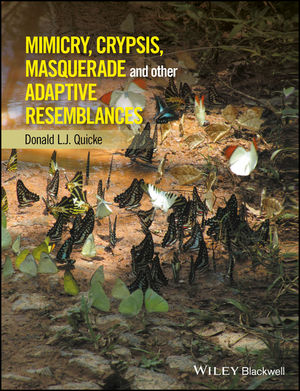
  • 書名     Mimicry, Crypsis, Masquerade and Other Adaptive Resemblances 
  • 作者     Donald L. J. Quicke 
  • 出版者 Wiley Blackwell 
  • ISBN    111893153X, 9781118931530 
  • 頁數     576 頁
擬態/警戒色的生物學進展相當快速,眾多的文章讓很多人難以一窺理論發展的全貌。這本書
縱觀自亨利貝茨十八世紀起的觀察,到近代的理論發展,將擬態生物學的基礎理論與實務發展做了相當清楚的整理,內容包含名詞的爭議與解釋、理論介紹、實務實驗介紹,與許多相關的實例等,這本書可說是未來擬態生物學相關領域的重要文獻。

作者原為Imperial College London生物科學系的教授,2013年退休後至曼谷的Chulalongkorn University作為訪問教授。主要研究領域有寄生蜂的系統分類、生態與演化,系統發生學方法,擬態與警戒色等諸多領域。

內容目錄

Preface 
Acknowledgements 
1 INTRODUCTION AND CLASSIFICATION OF MIMICRY SYSTEMS 
2 CAMOUFLAGE: CRYPSIS AND DISRUPTIVE COLOURATION IN ANIMALS 
3 CAMOUFLAGE: MASQUERADE 
4 APOSEMATISM AND ITS EVOLUTION 
5 ANTI-PREDATOR MIMICRY. I. MATHEMATICAL MODELS 
6 ANTI-PREDATOR MIMICRY. II. EXPERIMENTAL TESTS 
7 ANTI-PREDATOR MIMICRY. III. BATESIAN AND MULLERIAN EXAMPLES 
8 ANTI-PREDATOR MIMICRY. ATTACK DEFLECTION, SCHOOLING, ETC. 
9 ANTI-HERBIVORY DECEPTIONS 
10 AGGRESSIVE DECEPTIONS 
11 SEXUAL MIMICRIES IN ANIMALS (INCLUDING HUMANS) 
12 REPRODUCTIVE MIMICRIES IN PLANTS 
13 INTRA- AND INTERSPECIFIC COOPERATION, COMPETITION AND HIERARCHIES 
14 ADAPTIVE RESEMBLANCES AND DISPERSAL: SEEDS, SPORES AND EGGS 
15 MOLECULAR MIMICRY: PARASITES, PATHOGENS AND PLANTS 
Extended glossary 
References 
Author index 
General index 
Taxonomic index


相關書籍

  • Ruxton GD, Sherratt TN & Speed MP. 2004. Avoiding Attack: The Evolutionary Ecology of Crypsis, Warning Signals and Mimicry. Oxford University Press. 260 pp. 


Wrote by Chia-Hsuan Wei
圖片來自本文
原文標題:Identification of doublesex alleles associated with the female-limited Batesian mimicry polymorphism in Papilio memnon (open access)


摘要

The female-limited Batesian mimicry polymorphism in Papilio butterflies is an intriguing system for investigating the mechanism of maintenance of genetic polymorphisms. In Papilio polytes, an autosomal region encompassing the sex-determinant gene doublesex controls female-limited mimicry polymorphism. In the closely related species P. memnon, which also exhibits female-limited Batesian mimicry polymorphism, we identified two allelic sequences of the doublesex gene that corresponded exactly with the mimetic and non-mimetic female phenotypes. Thus, the genetic basis of the mimicry polymorphism in P. memnon is similar to that in P. polytes. However, the mimetic and non-mimetic alleles of the two species were not identical, and the divergence of alleles occurred independently in P. memnon and P. polytes. Different mutation-selection processes may have resulted in the convergent patterns of mimicry polymorphism in these Papilio butterflies.

自從控制非洲的白鳳蝶 (Papilio dardanus) 的雌性限性擬態/多態性翅紋的基因座發現後,來到2014年,控制玉帶鳳蝶雌性限性擬態/多態性的超基因 doublesex 的序列與機制也被發掘出來 (可參考這篇文章與這個新聞) 。那麼有著類似斑紋變化,同樣是經典的擬態案例的大鳳蝶呢?

同樣是京都大學的曾田貞滋教授團隊與師大生科系的林仲平教授合作的研究,在這篇文章中,他們發現控制大鳳蝶的超基因與玉帶鳳蝶相似,都位於doublesex這個基因座上,也有表現擬態的顯性 (H) 與隱性 (h)。然而,雖然大鳳蝶與玉帶鳳蝶是同一個亞屬,但兩種目的基因的序列並不相同,而且系統發生學的分析顯示兩者間的基因來源是獨立演化而來。

系統發生學分析顯示玉帶鳳蝶與大鳳蝶的親緣關係


以系統發生學的方式分析doublesex基因序列的關係,顯示大鳳蝶與玉帶鳳蝶間的基因來源是獨立演化而來

控制表型的基因在種間是獨立演化而來其實是滿普遍的現象,但為何這個研究要特地分析兩種的序列以證明其獨立演化來源呢?因為以毒蝶來說,控制斑紋的超基因是會藉由雜交而在不同族群間交換,如果把以系統發生學的方式分析毒蝶的超基因,會發現每個支系混雜不同的族群,而在這篇文章中可以發現兩者的分化顯著,顯示其推動基因演化的機制與毒蝶有所差異。


Wrote by Chia-Hsuan Wei
圖片來源:https://reefbuilders.com/2014/11/14/survival-reef-part-1-masquerading-false-colours/#


標題:Temporal dynamics of the mimetic allele frequency at the doublesex locus, which controls polymorphic Batesian mimicry in Papilio memnon butterflies (open access)

摘要

Tracking allele frequencies is essential for understanding how polymorphisms of adaptive traits are maintained. In Papilio memnon butterflies, which exhibit a female-limited Batesian mimicry polymorphism (wing-pattern polymorphism), two alleles at the doublesex (dsx) locus correspond to mimetic and non-mimetic forms in females; males carry both dsx alleles but display only the non-mimetic form. This polymorphism is thought to be maintained by a negative frequency-dependent selection. By tracking dsx allele frequencies in both sexes at a Taiwanese site over four years, we found that the mimetic allele persists at intermediate frequencies even when the unpalatable model papilionid butterflies (Pachliopta and Atrophaneura species) were very rare or absent. The rates of male mate choice did not differ between the two female forms; neither did insemination number nor age composition, suggesting equivalent reproductive performance of the two forms over time. Our results characterised the temporal dynamics of the mimetic allele frequency in the field for the first time and give insights into underlying processes involved in the persistence of the female-limited Batesian mimicry polymorphism.

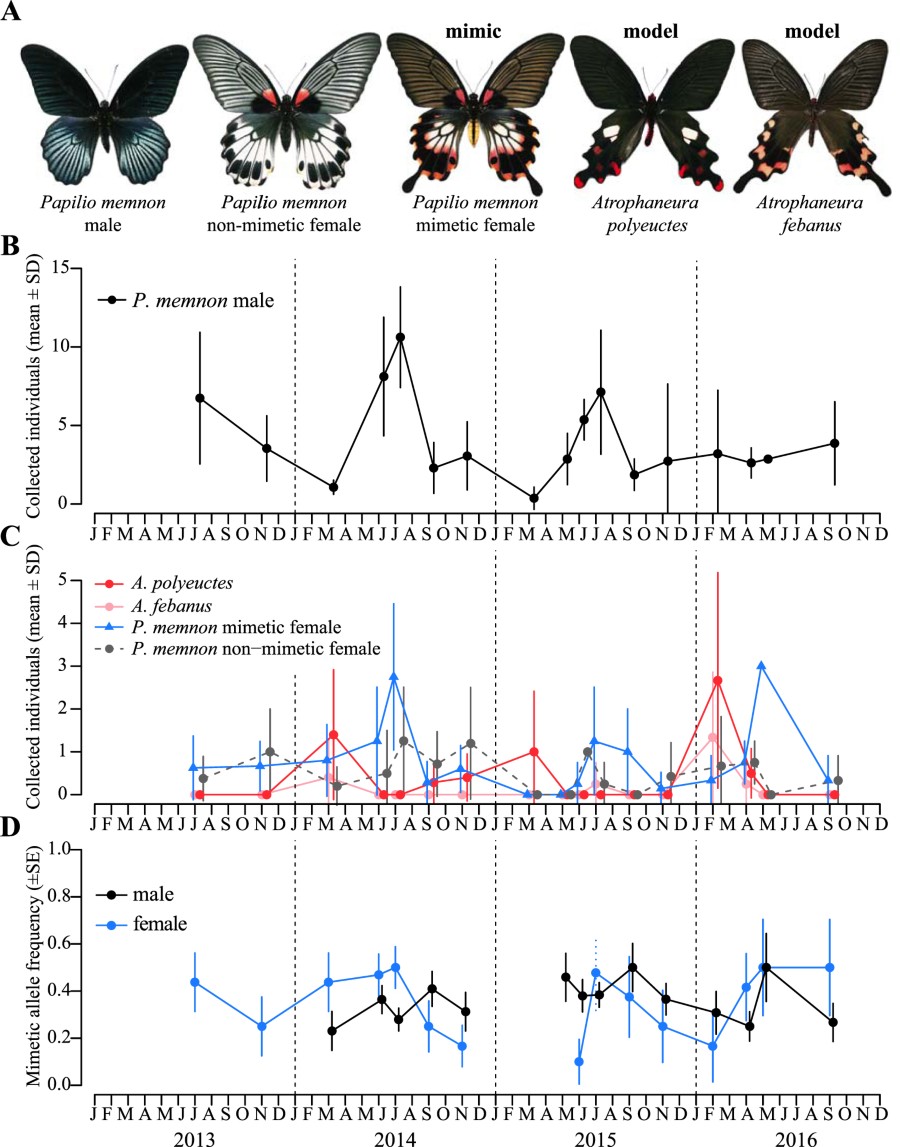
大鳳蝶是貝氏擬態的教科書經典案例,在亞洲對這個自家後院就看到的物種自不用說,而西方透過自華萊士時代的紀錄與研究,幾乎全世界都對這個例子的多態性、雌雄二態性與擬態間的關係與來源十分感興趣。這篇文章是京都大學的曾田貞滋教授 (Teiji Sota)及他的學生,與師大生科的林仲平教授合作,以台灣的大鳳蝶為材料,進行長達四年 (2013-2016) 的野外觀察與基因體研究的一部份成果。

這個研究的關鍵在於:首先,貝氏擬態的前提是以負向頻率(negative frequency-dependent selection)為選汰機制,意思也就是在已知的環境中,擬態者的數量不能過多,否則天敵遇到大部份的個體都能吃的話,這個擬態斑紋就可能失效。然而像斑紋高度多態性又牽涉雌雄二態的大鳳蝶,控制擬態的超基因 (supergene) 的族群基因頻率在環境中,如何在擬態與非擬態型中取得平衡就是個很有趣的問題了。


這個團隊執行了幾個部份的調查與實驗。(1) 他們在台灣花蓮以穿越線調查蝴蝶的狀況,並且分析其年齡、身體尺寸、天敵攻擊的咬痕,與交配的次數;(2) 分析大鳳蝶與其擬態模型紅紋鳳蝶 (Pachliopta aristolochiae)、大紅紋鳳蝶 (Atrophaneura polyeuctes) 與台灣麝香鳳蝶 (Atrophaneura febanus) 在這四年中的族群數量 (2) 設計行為的實驗測試大鳳蝶雄性對不同表型的雌性是否具有交配偏好;(3) 野外採集的個體帶回至實驗室進行分生的分析,將其基因型統計是否符合哈溫定律。主要的結果支持兩性的基因頻度的調查皆符合哈溫定律,而雄性無論對擬態或非擬態型的雌性都沒有特殊的擇偶偏好。在四年的觀察與採集中,doublesex的基因頻度維持在中等程度,並未因擬態模型的數量變動偵測到顯著變化,也未發現明顯的負向頻度選汰。也就是說,擬態模型在環境中的頻度與雄性無明顯擇偶偏好,都對doublesex的基因頻度沒有顯著的影響, 而這可能是大鳳蝶能夠維持斑紋多態性的原因。

===
以下是對這個研究的一些觀點:


  1. 這個研究的個體僅從花蓮取得,不知是否足以推及解釋台灣其他區域的族群。
  2.  一般來說,大鳳蝶的擬態對象認為是紅紋鳳蝶 (Pachliopta aristolochiae),而這個研究則認為不曾被紀錄是擬態對象的大紅紋鳳蝶 (Atrophaneura polyeuctes) 與台灣麝香鳳蝶 (Atrophaneura febanus) 也同時是其擬態模型。然而,紅紋鳳蝶與另兩種蝴蝶的棲地類型有所差異,根據這個研究的資料,在花蓮的研究地點紀錄的紅紋鳳蝶個體僅有1隻,遠低於大紅紋的21隻,有可能其觀測與採集地點並非天擇作用於擬態斑紋的主要活躍區域,因此擬態者的擬態模型與補食者的動物相的差異,可能影響基因頻率的觀察結果,而非單純的「維持在中等程度進而維持族群中翅紋的多態性」。若是未來能加入更廣泛區域的資料,能讓相關研究更加完整。
  3. 雖然大鳳蝶的擬態關係常被用來解釋擬態現象,但畢竟是以人類的視覺角度來觀察,而且大鳳蝶翅紋多態性的變化程度遠比想象中的高,如果一點點差異就會造成擬態效果的變化,那麼所謂「擬態型」的個體與其基因頻度或許要再評估。
Wrote by Chia-Hsuan Wei
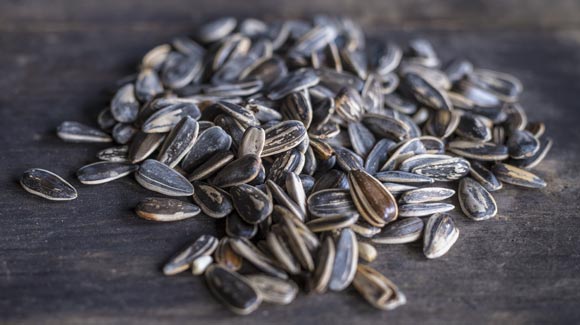
用來進行實驗的葵瓜子
photo: P. Allen Smith


標題:Protection by association: Evidence for aposematic commensalism

摘要

Aposematism is a well known and widely used strategy for reducing predation by conspicuous signalling of unprofitability. However, the increased conspicuousness could make this strategy costly if there are no secondary defences to back the signal up. This has made the elucidation of the evolutionary mechanisms for aposematism and that of the closely-related Batesian and Mullerian mimicry difficult. The present study aims to test whether cryptic and nondefended prey could reduce their predation risk by grouping with aposematic and defended prey. To do this, we used groups of artificial baits that were either cryptic and palatable or conspicuous and unpalatable, along with the corresponding control treatments. These were then presented in mixed and homogeneous treatment groups within a field setting and the local wild bird assemblage was allowed to select and remove baits at will. The results obtained show that undefended non-aposematic prey can benefit by grouping with aposematic prey, with no evidence that predation rates for aposematic prey were adversely affected by this association. These results provide insights into the evolution of Batesian mimicry.

警戒性是一種用來降低被捕食風險的策略,基本上是由警戒色加上次級防禦(化學、物理、行為)才能發揮作用,以演化的角度來看的話,性狀的演化會有些弔詭的地方:警戒色先出現而沒有次級防禦,耗費龐大的演化能量且可能反而吸引目光;先演化出次級防禦而沒有警戒色,無論如何被攻擊率都可能上升,被攻擊沒被吃掉但個體死亡,也會失去把性狀遺傳的可能性;天擇同時作用於兩者身上呢?概率實在太低了。因此在天擇的權衡下,警戒色演化的初期是個很難解釋的迷團。

作者群基於這個疑問,提出一個假設:隱蔽性的個體是否能藉著警戒性個體的保護傘降低被捕食者風險?作者群設計一連串的試驗,以葵瓜子染成紅色跟綠色,以奎寧做為次級防禦的化學物質,將紅色/綠色分別滴上奎寧製造出四種不同的組合,並將其實驗設計為紅色與綠色單色組與混色組,配上不同的數量,以瞭解各種因子的交叉作用。以上實驗都在英國格拉斯哥 (Glasgow) 市郊進行,各地至少觀察到八種不同的鳥類。

結論上來說,如果單純的以防禦機制來看的話,只要有滴上奎寧的組別,無論顏色的被捕食比例都比較低。把綠色(無防禦)比較混色組與單色組的話,會發現混色組的被捕食比例顯著較低,但反過來,綠色(有防禦)的組別不會降低紅色(無防禦)的被捕食比例。無論哪個統計都沒有個體數量上的顯著差異。


Table 3. 綠色(有防禦)與紅色(無防禦)的Mann-Whitney U-test統計結果
這個結果顯示隱蔽性的個體可能藉由與警戒性個體的混棲以降低被捕食的風險,可能是一個片利共生(commensalism,單方得利,另一方無損失)的一種現象。而這解釋部分警戒性與擬態在演化初期的問題:藉著與型態相似的警戒性物種混棲,來得到演化喘息的空間。但又有些問題產生了:第一個警戒性的個體怎麼來的呢?某些隱蔽色(褐色、綠色)完全沒可能在自然環境被當成不能吃的顏色嗎?

真是個雞生蛋,蛋生雞的問題。

此外,本篇的結果以數個難以看懂的表格呈現,請有志同仁務必避免。
Wrote by Chia-Hsuan Wei
photo: Olympic Naturual History Photos
標題:A comparative analysis of the evolution of imperfect mimicry

摘要

Although exceptional examples of adaptation are frequently celebrated, some outcomes of natural selection seem far from perfect. For example, many hoverflies (Diptera: Syrphidae) are harmless (Batesian) mimics of stinging Hymenoptera. However, although some hoverfly species are considered excellent mimics, other species bear only a superficial resemblance to their models and it is unclear why this is so. To evaluate hypotheses that have been put forward to explain interspecific variation in the mimetic fidelity of Palearctic Syrphidae we use a comparative approach. We show that the most plausible explanation is that predators impose less selection for mimetic fidelity on smaller hoverfly species because they are less profitable prey items. In particular, our findings, in combination with previous results, allow us to reject several key hypotheses for imperfect mimicry: first, human ratings of mimetic fidelity are positively correlated with both morphometric measures and avian rankings, indicating that variation in mimetic fidelity is not simply an illusion based on human perception; second, no species of syrphid maps out in multidimensional space as being intermediate in appearance between several different hymenopteran model species, as the multimodel hypothesis requires; and third, we find no evidence for a negative relationship between mimetic fidelity and abundance, which calls into question the kin-selection hypothesis. By contrast, a strong positive relationship between mimetic fidelity and body size supports the relaxed-selection hypothesis, suggesting that reduced predation pressure on less profitable prey species limits the selection for mimetic perfection.


不完美擬態 (imperfect mimicry) 指的是一個擬態物種(以人類觀點)猛一看很像A物種,但仔細端詳後又發現其實不太像,有時又會覺得很像B物種,但又覺得有差異,對人類來說就覺得「擬態的不完美」。這個看似對立於「完美擬態」的現象看似成立,其實存在著很多爭議,像是為什麼要有點不像?不像的部分對擬態也有貢獻?其實擬態兩個以上的物種?關於這些問題的研究產生很多對立的結果,到目前為止並未有一致的結論。

Fig. 1  食蚜蠅的斑紋分析,圓圈代表model,三角形代表mimics,白色代表蜜蜂型,灰色代表胡蜂型。
結果顯示兩型間的相似方向並不重疊。

Fig. 4 斑紋相似度與身體尺寸有強烈的正相關(詳細統計結果見原文)

這篇文章藉由比較性的方法來討論不完美擬態的演化來源。太細節的部分就姑且不談,作者群透過比較食蚜蠅 (hoverfly) 的型態(尺寸、斑紋與不同的接受者)與系統發生學的方式,發現以下幾個有趣的證據:

1. 透過型態的測量與鳥類的觀點來看,以人類的角度來判斷物種是否不完美擬態太過簡化這個現象;

2. 經過分析後發現,本來認為可能是擬態兩個擬態模型的食蚜蠅,其實沒有任何一個物種的斑紋實際上同時涉入兩種以上的擬態環,顯示「擬態多物種假說」值得存疑;

3. 沒有任何證據顯示擬態的精確度與物種豐度有負相關(物種數量越少,擬態的越精確),這可能與親屬選汰 (kin selection) 有關;

4. 擬態的精確度與身體尺寸有強烈的正相關,支持緩和選汰假說 (relaxed-selection hypothesis),顯示獲益較少的物種受到較少的捕食壓力,影響擬態精確度的選汰。

這個研究以食蚜蠅為例子是因為那實在是不完美擬態的典範,然而這篇文章並非完全解答這個現象,至少就食蚜蠅的總物種數來說,文中討論的物種數比例上不算多,有可能陷入見樹不見林的風險。不完美擬態也廣泛的發生在各種其他類群的昆蟲上,這個研究的論點是基於「不完美擬態是到目前為止的終點」,但更多觀察到的現象讓我們覺得「不完美擬態可能只是完美擬態的過程」,代表不同的類群不同的演化故事,帶來的結論可能大相逕庭。

Wrote by Chia-Hsuan Wei
photo from Papilio dardanus (wiki)


標題:Characterising the phenotypic diversity of Papilio dardanus wing patterns using an extensive museum collection.

摘要

The history of 20th Century evolutionary biology can be followed through the study of mimetic butterflies. From the initial findings of discontinuous polymorphism through the debates regarding the evolution of mimicry and the step-size of evolutionary change, to the studies on supergene evolution and molecular characterisation of butterfly genomes, mimetic butterflies have been at the heart of evolutionary thought for over 100 years. During this time, few species have received as much attention and in-depth study as Papilio dardanus. To assist all aspects of mimicry research, we present a complete data-derived overview of the extent of polymorphism within this species. Using historical samples permanently held by the NHM London, we document the extent of phenotypic variation and characterise the diversity present in each of the subspecies and how it varies across Africa. We also demonstrate an association between ‘‘imperfect’’ mimetic forms and the transitional race formed in the area where Eastern and Western African populations meet around Lake Victoria. We present a novel portal for access to this collection, www.mimeticbutterflies.org, allowing remote access to this unique repository. It is hoped that this online resource can act as a nucleus for the sharing and dissemination of other collections databases and imagery connected with mimetic butterflies.

非洲白鳳蝶的多態型,左上方框內是雄性,線的上方是各種斑蝶與細蝶,線的下方是各型雌性白鳳蝶
photo from mimeticbutterflies.org

非洲的白鳳蝶(Papilio dardanus)是知名的貝氏擬態的鳳蝶,其豐富的多態型各自擬態非洲各地的細蝶、斑蝶等不好吃的種類。白鳳蝶的擬態實際上只有雌性參與其中,而雄性只有一種型態,在多態型的雌性中,除了擬態各種不同的蝴蝶外,神奇的也存在雄性型的雌性。

1960年代,透過孟德爾式的遺傳學雜交試驗瞭解不同族群間的斑紋變化,而且結果顯示白鳳蝶的斑紋變化是來自一個超基因;到了2008年,基於現代的分生技術,終於找到超基因的位置。即使如此,雌性的型態實在太多了,除了上面這些看起來精準擬態的斑紋外,也有更多看起來是中間型的種類,因此雖然已經研究到基因體層級的情況下,基礎的斑紋與地理分佈還沒有整體性的調查過。

雌性各種不同的型與名稱
photo from Fig. 1
這篇透過英國倫敦自然史博物館(the Natural History Museum, London)的極大量鱗翅目館藏,蒐集標籤上的採集資訊,將採集的地點轉換成現代的地點並查出座標,把各個不同的斑紋分類後,再轉換為二維座標系統輸入地理資訊系統 (GIS),把各個不同的斑紋分類後,就能每個型態的分佈呈現在現代的地圖上,並且透過採集點的連線,推估分佈範圍。

取樣密度與地點
photo from Fig. 3
各型的分佈範圍
photo from Fig. 6
結果就如上圖,把大部分的斑紋的分佈範圍推估出來,而那些看起來不完美擬態的斑紋分佈於維多利亞湖附近,支持這是西部與東部族群相遇的雜交區。

中間型的分佈區域
photo from Fig. 7
這分析的概念很簡單,但卻是瞭解一個擬態群的多樣性最快的方式,而且最重要的,這仰賴保存完整與大量的標本館藏。這樣的研究說明透過良好的想法與完整的分析,即使基礎的研究也能從中得到大量的資訊,也更凸顯標本蒐藏的重要性。

Wrote by Chia-Hsuan Wei
photo from Morpho menelaus (wiki)
標題:Both Palatable and Unpalatable Butterflies Use Bright Colors to Signal Difficulty of Capture to Predators

摘要

Birds are able to recognize and learn to avoid attacking unpalatable, chemically defended butterflies after unpleasant experiences with them. It has also been suggested that birds learn to avoid prey that are efficient at escaping. This, however, remains poorly documented. Here, we argue that butterflies may utilize a variety of escape tactics against insectivorous birds and review evidence that birds avoid attacking butterflies that are hard to catch. We suggest that signaling difficulty of capture to predators is a widespread phenomenon in butterflies, and this ability may not be limited to palatable butterflies. The possibility that both palatable and unpalatable species signal difficulty of capture has not been fully explored, but helps explain the existence of aposematic coloration and escape mimicry in butterflies lacking defensive chemicals. This possibility may also change the role that putative Müllerian and Batesian mimics play in a variety of classical mimicry rings, thus opening new perspectives in the evolution of mimicry in butterflies.

無論是警戒色或是擬態,理論告訴我們這些物種所使用的是化學性的物質來防禦,無論是散發難聞的氣味,或是咬下去覺得噁心苦澀難吃想吐,讓捕食者徹底的記得這個「教訓」,就能夠提升整體的適存度。

所有的例子都是用化學機制來防禦嗎?前兩年以球背象鼻蟲的例子做的行為實驗的證據支持,物理性的硬度也可以用來做為防禦,或是身上長刺之類的。此外,野外觀察者通常有經驗,譬如說我們看到青帶鳳蝶通常飛的很快,要抓到牠很困難,要拍到也不容易,如果是在大熱天飛的更快,更不會是觀察者拍照的首選:因為要追上實在太累了。有意思的是在中國南方也有擬態青帶鳳蝶的物種,但沒有證據支持其擬態關係,僅是人類視角看起來很像。

作者討論的蝴蝶之一,摩爾福蝶。背面與腹面差異很大,其飛行行為讓人覺得很難追。
photo from Morpho menelaus (wiki)
以這個想法來推測,我們覺得追上去很累,那麼捕食者要追是不是也會很累?如果這些訊號代表的不是「我很難吃」,而是「我很難抓」呢?捕食者看到就覺得好累,是不是就會放棄捕捉了呢?

文章中的範例之一,Parides anchises nephalion
photo from Aluisio Ribeiro
這篇文章以新熱帶區的蝴蝶為例子,某些不具有化學防禦的物種,可是又具有很明亮的色彩,如果不具有防禦的話,不是很容易被捕食者攻擊嗎?因此作者假設無論是能吃還是不能吃的蝴蝶,這些看起來明顯的訊號遍佈所有的蝴蝶,可能是因為代表不容易被捕捉,讓捕食者放棄。作者整理出看起來很明顯的斑紋與相關物種,以及比較代表好吃或不好吃的行為,看看這是不是有什麼趨勢。

最後的結論很簡單,就是我們對這個現象依然知道的太少,以目前的資料還看不出什麼趨勢。作者認為如果朝著這個方向研究,能夠提供解釋擬態/警戒色演化的新方向。

--
可能有人會覺得這個方向很重要嗎?不就是把化學改成物理,獵物一樣難吃而已?

其實機動性這件事情不是沒有人研究過,但證據實在太難捕捉。試想,要如何去證明某些特定的飛行方式是「困難」,哪些是「容易」捕捉呢?捕食者不吃,可以有很多種理由,如果要做這樣的行為實驗,又要有多大的空間,才能讓捕食者與蝴蝶同時表現出如同自然般的行為呢?此外,「覺得不能吃」與「覺得累不想去抓」是兩種完全不同的認知模式,或許不是單純的把某些因子替換掉就能輕易的解釋這樣的現象。

總之,是個有趣但很難做的方向。(換句話說就是藍海)
Wrote by Chia-Hsuan Wei
photo from wongchunxing.com
Myrmarachne Merotai (非本實驗中用種類)
標題:Locomotory mimicry in ant-like spiders

摘要

The jumping spider genus Myrmarachne (Salticidae) consists of over 200 species of morphologically accurate ant mimics, enabling Myrmarachne to evade ant-averse predators that confuse the spiders with ants (Batesian mimicry). A conspicuous but untested trait of Myrmarachne, which is frequently mentioned in the literature, is locomotory mimicry. For these spiders, locomotion that is more ant like than salticid like may be an integral part of the suite of mimetic signals. We quantified the locomotory pattern of several species of non-ant-like salticids, Myrmarachne, and ants from Australia. We found that the locomotion of the mimics generally resembles that of ants, but not of other salticids. To tease out the effects of locomotion from those based on morphology, ant-eating salticids as visual predators were presented with 3D animations of ant-like salticids walking either in ant or in salticid fashion. Ant-eating salticids spent significantly longer looking at the stimulus with ant-like movement and were significantly more likely to visually track and stalk the stimulus with ant-like movement. Overall, our results suggest that there is selection pressure on Myrmarachne for increased resemblance to a model by locomotor mimicry, despite the associated costs when faced with ant-eating predators.

蟻蛛屬 (Myrmarachne,跳蛛科)全世界超過200種,令人驚訝的是精確的擬態各種螞蟻的型態與行為,可能帶給這群跳蛛躲避其他天敵的好處,被認為是一種貝氏擬態。但令人疑惑的是,跳蛛科有另外一群種類是專吃螞蟻的,蟻蛛也可能被其他專吃螞蟻的跳蛛攻擊,這樣擬態螞蟻反而可能承受更大的風險,使得科學家一直想弄清楚這群蟻蛛到底是想怎樣?

雖然以人類的角度來看,蟻蛛看起來像螞蟻,走起來像螞蟻,可是有科學上的證據嗎?意外的不多,大部分是觀察式的證據,因此這篇文章的作者們想透過分析澳洲的蟻蛛與螞蟻的行為比較,還有為了弄清楚行為與型態對擬態的貢獻,也把蟻蛛的3D影像播放給吃螞蟻蜘蛛看,同時藉由科學上的行為分析與捕食者的觀點來分析,蟻蛛到底像不像螞蟻。


實驗中觀察的種類之一,Myrmarachne smaragdina,Darwin, Female
photo from Dr. Greg Anderson

行為的紀錄分為三個類型:非螞蟻型跳蛛(其他跳蛛)、蟻蛛與螞蟻的行為模式,分析蟻蛛的行為究竟比較偏向普通的跳蛛,還是比較類似於螞蟻。行為的實驗則透過3D動畫建模,做出蟻蛛的型態,但行為分別是螞蟻與普通跳蛛的動畫,然後播放給吃螞蟻的跳蛛看(給蜘蛛看卡通的意思),分析蟻蛛究竟是透過行為或是型態來欺騙捕食者。

結果顯示蟻蛛的行為的確比較接近螞蟻而非像其他的跳蛛。吃螞蟻的跳蛛花了比較長的時間在螞蟻行為的蟻蛛影像上,顯示即使對捕食者來說,蟻蛛的行為也非常像螞蟻。因此總和來說,雖然偶爾可能面對來自吃螞蟻的蜘蛛的風險,蟻蛛的確受到某些未知的天擇壓力,迫使這樣精確擬態螞蟻的型態與行為留存。
Wrote by Chia-Hsuan Wei
大杜鵑 (Cuculus canorus)
photo from ouse washes
標題:Hawk models, hawk mimics, and antipredator behavior of prey.

摘要

Prey typically respond to potential predators by taking flight. This results in an optimal flight initiation distance (FID) at which the risk of remaining and the cost of flight are equal. Thus, FID is strongly negatively correlated with susceptibility to predation by the sparrowhawk Accipiter nisus across species of small European birds. However, not everything that looks like a hawk is in fact a hawk. Aggressive mimicry arises from the resemblance between a dangerous model such as a predatory hawk and an innocuous mimic such as a cuckoo that makes errors made by individuals that encounter models and mimics potentially dangerous and life threatening. A prime example of such aggressive mimicry is the hawk-like appearance of common cuckoos Cuculus canorus and other cuckoos. If mimicry is efficient, we should expect that species of small birds that are prey of hawks and hosts of cuckoos react just as strongly to a cuckoo as to the presence of a dangerous model like a sparrowhawk. We used FID of small birds as a measure of the reaction of prey to models and mimics, predicting that FID would be negatively related to susceptibility to predation and positively to risk of cuckoo parasitism. Both susceptibility to sparrowhawk predation and rate of brood parasitism by the common cuckoo independently explained variation in FID, consistent with the expectation that both hawks and cuckoos have imposed significant selection pressures on FID and that species of small birds perceive cuckoos as true mimics of hawks.

獵物遇到天敵要逃跑的時候,通常會評估「到底要不要跑?」

覺得奇怪嗎?遇到天敵,先跑,就對了啊,難道還等天敵到面前了才傻傻的要跑嗎?

對於野外一天到晚被人盯著瞧,隨時可能被吃掉的物種來說,隨時隨地都可能遇到天敵,但不是隨時隨地都有力氣可以跑,如果太早跑反而提早被發現,因此這些物種會評估到底捕食者離我多近才要跑,這稱為flight initiation distance (FID),也可以叫做初始逃跑距離,就是捕食者離我到多近的食後才開始逃跑。那麼為什麼會有這個距離呢?因為有些獵物身上有些隱蔽色或有些警戒色之類用來躲避天敵的機制,如果捕食者雖然靠的很近但其實沒發現,那麼就不用浪費力氣逃跑,可是相對的會遭遇非常高的風險:萬一被發現就跑不掉了。

雀鷹 (Accipiter nisus)
photo from Eurasian sparrow hawk (wiki)

那麼有意思的事情就發生了。大杜鵑 (Cuculus canorus)眾所皆知,有把蛋下在別人的巢裡,讓別的鳥幫牠孵蛋的行為。有人覺得大杜鵑長的像雀鷹 (Accipiter nisus),早期的科學家認為這是一種貝氏擬態,但後來發現有另一種可能:這些大杜鵑長的像雀鷹,把那些要幫牠孵蛋的鳥嚇走,大杜鵑就能順利的去這些鳥的巢裡下蛋了?

作者藉由測量那些幫忙孵蛋的小型鳥的FID來測試這件事。之前有研究顯示,歐洲的小型鳥的FID與感知捕食的壓力的平衡點是負相關(體型越小靠的越近),因此如果小型鳥感應到的是捕食壓力,那麼應該是負相關,如果感知到的是普通的杜鵑偷生蛋行為,則是正相關。大杜鵑看起來就像雀鷹的話,那麼小型鳥的FID應該會與看到雀鷹的FID結果相似。作者觀察了63種鳥類行為的結果顯示,雖然某些小型鳥對大杜鵑的反應就像對雀鷹一樣,但相較於捕食的壓力,對於認知「杜鵑來下蛋」這件事還是比較強烈,因此大杜鵑擬態雀鷹可能有侵略型擬態的作用,但作者還是認為這還是種貝氏擬態,功用可能在於寄生到比較兇的寄主時,不會被這些寄主反過來攻擊甚至喪命。綜合以上顯示兩種行為都帶給這些小型鳥不同的壓力,這使FID的測量與結果可能來自於更為複合的行為觀察才能解釋。
Wrote by Chia-Hsuan Wei
photo from BugGuide
標題:The evolution of Batesian mimicry within the North American Asidini (Coleoptera: Tenebrionidae).

摘要

The asidine darkling beetles (Coleoptera: Tenebrionidae: Asidini) are a diverse tribe of flightless tenebrionids found in many arid and sub-arid habitats around the world. The 263 currently described North American species are contained in ten genera, all of which are restricted to the western half of the continent. The Asidini, like all members of the subfamily Pimeliinae, lack defensive glands. Instead, several phenotypic traits occur within the tribe that may help limit predation. These include the contrasting defensive strategies of crypsis, through either background matching or pattern disruption, and Batesian mimicry of the chemically defended genus Eleodes. Dorsal elytral morphology was assessed between 53 North American asidine species and 13 common Eleodes model species using multiple methodologies to assess similarities between species in the two groups that might indicate mimetic relationships. A phylogeny of the North American asidines is used to map the occurrence of differing defensive strategies within the tribe. Crypsis is reconstructed as the ancestral state, with two origins for Batesian mimicry and multiple reversals. The combination of strongly to weakly cryptic species and varying levels of mimetic fidelity to Eleodes model species make the asidines a promising lineage upon which to further explore the evolution of defensive phenotypes.
八種顯示隱蔽色的Pelecyphorus spp
photo from Fig. 1
這個研究所說的是北美的一個擬步行蟲科(Tenebrionidae)其下的一個族 Asidini (漠甲亞科,Pimeliinae)的貝氏擬態斑紋的演化,若要瞭解這個文章,要先配合另一篇文章,Phylogenetic revision of the North American Asidini (Coleoptera: Tenebrionidae)來看。這個族共包含263種,所有的種類都缺乏防禦腺體(可能是不會臭),整個族都棲息在乾燥的環境(可能是沙漠或周遭),大部分的種類都看起來像沙子的顏色,但有幾個種看起來像另一類的擬步行蟲 Eleodes spp.,因此作者對於這些看起來擬態的斑紋的演化趨勢有興趣。整體的架構是這樣,作者先發表了整個族的系統發生學,然後才有這篇討論斑紋演化的文章。

photo from Fig. 2
中間、正下方、左下為擬態者Stenomorpha spp.
其餘為擬態模型Eleodes spp.
研究中使用了11個背方的特徵,這些特徵看起來跟Eleodes spp.的擬態是有關聯的,如果是這樣的話,那把這兩類的物種同時放在一個分析矩陣下跑樹的話,兩者應該會跑在一起,而且有可能可以找出哪些特徵讓兩者看起來這麼像。另一方面作者使用這個族的樹,把擬態的特徵映象至樹上,追溯這些斑紋在樹上的變化,就能瞭解演化趨勢。

結果發現支持這兩類看起來想似的主要特徵是「背面不反光」與「顏色斑紋單一」,而整體的演化趨勢來看的話,如同大部分其他的例子,隱蔽色是祖徵,可能與Eleodes spp.的擬態特徵是複數起源。

雖然說擬態起來的相似度還是要從整體的行為斑紋來看,但分別把特徵拆開追溯其演化趨勢,有助於讓我們了解究竟相似度從何而來,也可以為未來更細膩的研究打下基礎。
Wrote by Chia-Hsuan Wei
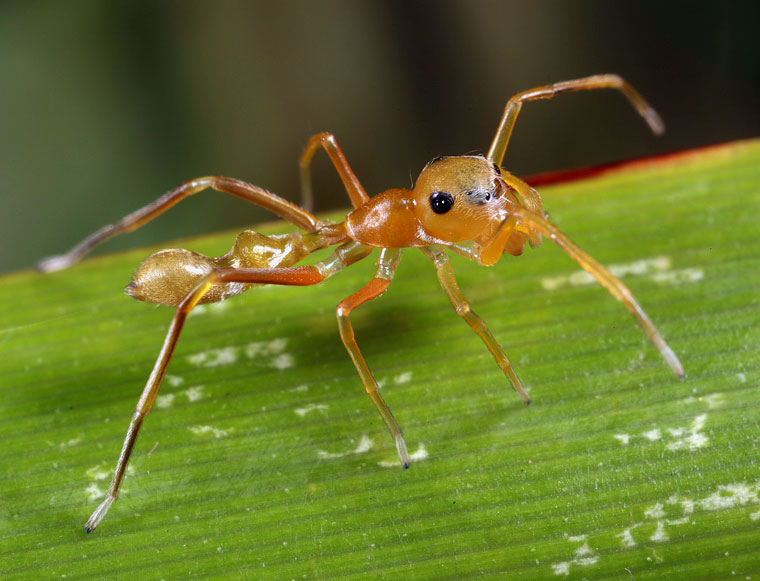
photo from K. Kunte


標題:A genetic mechanism for female-limited Batesian mimicry in Papilio butterfly.

摘要

In Batesian mimicry, animals avoid predation by resembling distasteful models. In the swallowtail butterfly Papilio polytes, only mimetic-form females resemble the unpalatable butterfly Pachliopta aristolochiae. A recent report showed that a single gene, doublesex (dsx), controls this mimicry; however, the detailed molecular mechanisms remain unclear. Here we determined two whole-genome sequences of P. polytes and a related species, Papilio xuthus, identifying a single ~130-kb autosomal inversion, including dsx, between mimetic (H-type) and non-mimetic (h-type) chromosomes in P. polytes. This inversion is associated with the mimicry-related locus H, as identified by linkage mapping. Knockdown experiments demonstrated that female-specific dsx isoforms expressed from the inverted H allele (dsx(H)) induce mimetic coloration patterns and simultaneously repress non-mimetic patterns. In contrast, dsx(h) does not alter mimetic patterns. We propose that dsx(H) switches the coloration of predetermined wing patterns and that female-limited polymorphism is tightly maintained by chromosomal inversion.

說起玉帶鳳蝶(Papilio polytes)的故事,可真是源遠流長。早在Wallace的年代(1864)就記錄了玉帶鳳蝶(那時叫Papilio pammon)與Pachiliopta hector這種麝鳳蝶的擬態關係,還記錄了三種不同的雌性型;1913年Punnet的"Mimicry in Butterflies"的書中特別把玉帶鳳蝶的擬態這件事拿出來重新整理;然後又到了1960年代,Clarke and Sheppard這兩位把當時能養的關於擬態的鳳蝶都拿來雜交做孟德爾式的遺傳實驗,當時的目標包含大鳳蝶、玉帶鳳蝶與非洲的白鳳蝶,結果提出控制擬態斑紋的基因是個超基因(supergene)的觀點與間接證據。直到前兩年(2014)正式確認了玉帶鳳蝶中控制擬態斑紋的基因是個叫做doublesex (dsx)的超基因。

這篇延續2014年的觀點,繼續討論基因體內部發生的事。雖然這個dsx的基因被找到了,可是我們還不像毒蝶那樣瞭解這個基因實際上是怎麼對表型產生影響,於是就來了個全基因體定序,比較擬態型與非擬態型來推測這個基因是怎麼作用的。

photo from Fig 3
經過一連串的分析,作者們發現一個奇妙的現象:dsx控制擬態斑紋是來自基因的倒轉(inversion),就是說如果dsx序列倒轉的話,個體就會出現擬態的斑紋,如果沒有的話,就出現雄性型(非擬態型)的斑紋。
基因knockdown後,不同處理的斑紋表現
photo from Fig. 5

作者同時也想知道這個基因控制那個部分的斑紋,然而傳統孟德爾式遺傳學的方法花時間又不精確,於是他們把這個基因用現代的knockdown技術,減低這個基因的表現,就會呈現如上圖,不同處理下翅紋的表現不同,經過比對後就知道dsx控制了哪些部分的斑紋。

至此,玉帶鳳蝶的故事就結束了嗎?還記得毒蝶的天擇與性擇的影響,族群間的基因傳遞,有沒有可能影響種化等等,都可能在玉帶鳳蝶身上發生,瞭解這樣的分子生物學機轉無疑是替未來的研究打下基礎。
Wrote by Chia-Hsuan Wei

左圖為有毒的珊瑚蛇,右圖為無毒擬態者猩紅王蛇
標題:Batesian mimicry promotes pre- and postmating isolation in a snake mimicry complex.

摘要

We evaluated whether Batesian mimicry promotes early-stage reproductive isolation. Many Batesian mimics occur not only in sympatry with their model (as expected), but also in allopatry. As a consequence of local adaptation within both sympatry (where mimetic traits are favored) and allopatry (where nonmimetic traits are favored), divergent, predator-mediated natural selection should disfavor immigrants between these selective environments as well as any between-environment hybrids. This selection might form the basis for both pre- and postmating isolation, respectively.We tested for such selection in a snake mimicry complex by placing clay replicas of sympatric, allopatric, or hybrid phenotypes in both sympatry and allopatry and measuring predation attempts. As predicted, replicas with immigrant phenotypes were disfavored in both selective environments. Replicas with hybrid phenotypes were also disfavored, but only in a region of sympatry where previous studies have detected strong selection favoring precise mimicry. By fostering immigrant inviability and ecologically dependent selection against hybrids (at least in some habitats), Batesian mimicry might therefore promote reproductive isolation. Thus, although Batesian mimicry has long been viewed as a mechanism for convergent evolution, it might play an underappreciated role in fueling divergent evolution and possibly even the evolution of reproductive isolation and speciation.

穆氏擬態的毒蝶 (Heliconius spp.)因為其環境的壓力(天擇)與自身的擇偶偏好(性擇),共同造就其不同區域的多態型,一些科學家認為不同的型態區隔或許可以是生殖隔離乃至種化的起源,也從早期的研究中找到部分的證據支持這個理論。然而因為擬態群特性的緣故,地理型態區隔不明顯等等,貝氏擬態或許也有一樣的現象,但支持的證據卻少之又少。

猩紅王蛇 (scarlet king snake, Lampropeltis elapsoides)與珊瑚蛇(coral snake, Micrurus fulvius)是新北區東南方著名的脊椎動物的貝氏擬態案例,可是自從被發現以來爭議不斷,主要是因為早期對於不太精確的擬態斑紋,以及有點無法解釋的分佈產生的疑惑,而近十年對於這個擬態群的研究我們對於這個擬態群又更瞭解了一些,包含猩紅王蛇的分佈其實比起珊瑚蛇來的廣,兩者分佈不重疊的區域擬態就就不精確,而造成這種分佈的原因可能來自廣域性的捕食者(猛禽)等等。這時候就產生疑問了,如果分佈共域/異域的型態不一樣,那有沒有可能像毒蝶那樣,有機會產生生殖隔離呢?

作者使用的黏土模型,由上而下為共域型/雜交型/異域型
photo from Fig. 3

這個研究簡單的討論了這個問題,作者假設如果不同型態的族群無法進入不同的區域的話,不同型態的個體根本沒辦法遇見彼此,就會發生生殖前隔離(premating isolation);而若是兩種型態在雜交帶產下中間型的個體,捕食者(天擇)不知道這是什麼就把牠吃了,那麼透過雜交帶的基因傳遞功能失效,就會產生生殖後隔離(postmating isolaiton)。作者用黏土做成三種不同的型態,分別是精確型/雜交型/不精確型,分別把這些型交叉測試,譬如把精確型放到異域的區域裡或者相反,測試這些型態的被攻擊率。

結果如同預期,不同型態在不同區域的確被攻擊的比率比較高,可是雜交型只有在共域的沙丘環境上被攻擊的比率比較高,其他環境統計上不顯著。因此作者認為,貝氏擬態的確有可能造成族群間的隔離(對雜交型來說,至少某些環境遭遇比較強的天擇壓力),進而造成生殖隔離乃至種化。

至於那個黏土模型.....好像挺微妙的?下次看作者會不會改成3D列印,搞不好做出來結果有差。
Wrote by Chia-Hsuan Wei
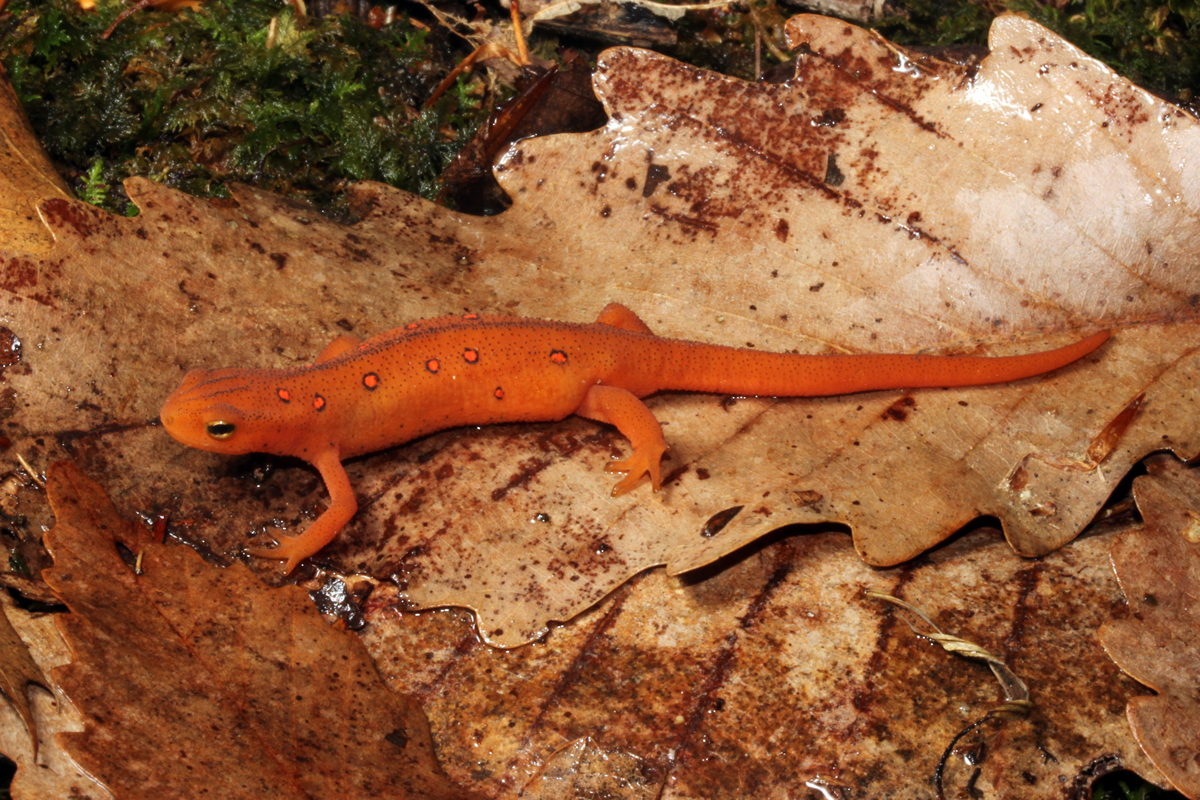
北美火焰蠑螈 (Plethodon cinereus)
photo from Salamander Chronicles
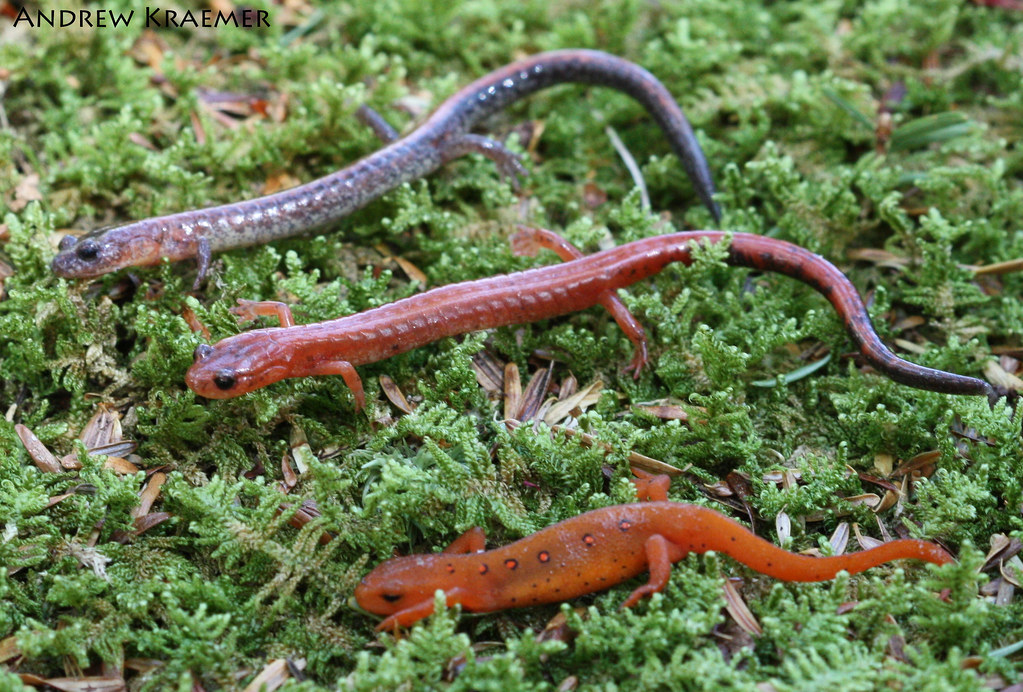
由下而上為火焰蠑螈(model),紅背蠑螈紅化型(mimic),紅背蠑螈黑色型(non-mimetic)
photo from Andy Kraemer
標題:Model toxin level does not directly influence the evolution of mimicry in the salamander Plethodon cinereus.

摘要

The resemblance between palatable mimics and unpalatable models in Batesian mimicry systems is tempered by many factors, including the toxicity of the model species. Model toxicity is thought to influence both the occurrence of mimicry and the evolution of mimetic phenotypes, such that mimicry is most likely to persist when models are particularly toxic. Additionally, model toxicity may influence the evolution of mimetic phenotype by allowing inaccurate mimicry to evolve through a mechanism termed ‘relaxed selection’. We tested these hypotheses in a salamander mimicry system between the model Notophthalmus viridescens and the mimic Plethodon cinereus, in which N. viridescens toxicity takes the form of tetrodotoxin. Surprisingly, though we discovered geographic variation in model toxin level, we found no support for the hypotheses that model toxicity directly influences either the occurrence of mimicry or the evolution of mimic phenotype. Instead, a link between N. viridescens size and toxicity may indirectly lead to relaxed selection in this mimicry system. Additionally, limitations of predator perception or variation in the rate of phenotypic evolution of models and mimics may account for the evolution of imperfect mimicry in this salamander species. Finally, variation in predator communities among localities or modern changes in environmental conditions may contribute to the patchy occurrence of mimicry in P. cinereus.


擬態生物學裡有一個理論:想像一下,如果我們是個捕食者,在找尋獵物,突然看到一個生物看起來可以吃,咬下去之後發現,難吃但勉強能吃,為了填肚子硬吞下去,但是如果有別的選擇我可以別選這種難吃的東西,接著又發現另一隻,欸?這看起來跟剛剛那個沒這麼像,是不一樣的東西,吃下去發現,恩,好吃。回到一開始,另一個情境,一樣看到一個生物,咬下去吃後發現,這東西天殺的無敵霹靂盤古開天以來都沒那麼難吃的東西居然被我吃到!吐掉,接著又發現另一隻看起來有點像,這時你還會想嘗試第二次嗎?

這就是在說model的毒性(難吃)程度與mimic的擬態精準度之間的關係,如果model很難吃,那麼可以忍受mimic沒那麼像,如果model中等難吃,那mimic的斑紋就要像的精準一點。

photo from Virginia Herpetological Society
紅背蠑螈的不同型態變化

這個研究討論的是一個具有河豚神經毒素的北美的火焰蠑螈 (Notophthalmus viridescens)的毒性程度,與牠的擬態者紅背蠑螈 (Plethodon cinereus)間斑紋變化的關係。紅背蠑螈是一個多態型的種類,而火焰蠑螈的毒性在不同地區有所差異,如果上述的理論為真的話,那麼紅背蠑螈在火焰蠑螈毒性比較高的地方擬態會比較沒那麼精準,較低的地方會比較精準。作者分為兩個方向處理,一個是對火焰蠑螈的河豚毒素(tetrodotoxin)定量,一個是從野外捕捉紅背蠑螈,藉由測量反射光譜比較擬態的精準度。

結果發現河豚毒素的多寡跟擬態的斑紋精準度沒有直接關係,反而加入火焰蠑螈體型尺寸的話還有一些間接的相關。所以這個擬態系統的演化應該還是要從當地的捕食者角度來看,才能知道這個擬態關係是如何運作。

這篇文章做了一個很重要但通常在擬態生物學都不會去做的是,就是把毒性定量出來,明確的指出毒性的變化,回到源頭就會變成副貝氏你與穆氏擬態的爭議,而這也影響捕食者對於擬態群行為上的差異。科學家其實都知道這很重要,但不做的原因大多來自於不知道確切的化合物是什麼,不知道這些毒素儲存在哪裡,沒有相關技術等等,都限制探索這些生物的化學生態的研究。目前跟擬態相關瞭解比較多的化學生態是斑蝶與毒蝶,其實還有更多東西可以等著對跨界研究有興趣的人來加入。

最後,個人看法,雖然這群作者努力的說這兩種間的擬態關係如何如何,但接連三篇的研究看完覺得,這兩種蠑螈會不會不存在擬態關係?


相關文章見此
  1. 捕食者的受覺與北美蠑螈間體色的貝氏擬態與警醒程度的關係
  2. 北美的貝氏擬態的蠑螈顯示擬態者也能影響擬態系統的演化方向
Wrote by Chia-Hsuan Wei
文中的擬態者 勞旦橫口鳚 (Plagiotremus laudandus)
photo from Dianne J. Bray, 2011, Bicolor Fangblenny, Plagiotremus laudandus, in Fishes of Australia
文章中的被擬態者,金鰭稀棘䲁 (Meiacanthus atrodorsalis)
photo: Dianne J. Bray, 2011, Eyelash Fangblenny, Meiacanthus atrodorsalis, in Fishes of Australia, accessed 31 Mar 2016

標題:Multiple selective pressures apply to a coral reef fish mimic: a case of Batesian-aggressive mimicry.

摘要

Mimics closely resemble unrelated species to avoid predation, capture prey or gain access to hosts or reproductive opportunities. However, the classification of mimicry systems into three established evolutionary mechanisms (protection, reproduction and foraging) can be contentious because multiple benefits may be gained by mimics, causing the evolution of such systems to be driven by more than one selective agent. However, data on such systems are generally speculative or anecdotal. This study provides empirical evidence that dual benefits apply to a coral reef fish mimic in terms of increased access to food (aggressive mimicry) and reduced predation risk (Batesian mimicry). Bicolour fangblennies Plagiotremus laudandus gained access to more reef fish victims, which they attack to feed on fins and scales, when they spent more time associated with their model Meiacanthus atrodorsalis. Furthermore, exact replicas of P. laudandus incurred fewer approaches from potential predators compared with control replicas that varied in resemblance to P. laudandus. Predators with trichromatic visual systems (three distinct spectral sensitivities) could potentially distinguish between replicas based on colour based on theoretical vision models. Therefore, this mimicry system could be best described as Batesian–aggressive mimicry in which mimicry evolution is driven by multiple simultaneous selective pressures.

photo from Fig. 1
a) i. 金鰭稀棘鳚 (Meiacanthus atrodorsalis) ii. 勞旦橫口鳚 (Plagiotremus laudandus)
b) 三種手工實驗用假魚與控制組物種粗吻橫口鳚 (P. rhinorhynchos)
通常科學家會把牽涉擬態的物種歸類,譬如說這是貝氏擬態,那是穆氏擬態,也有可能是介於兩者間的負貝氏擬態,那麼會不會有一個物種同時牽涉兩種擬態的系統呢?

這個研究地點在印尼蘇拉維西東南方的10個珊瑚礁,這個系統是兩種珊瑚礁魚類,勞旦橫口鳚 (Plagiotremus laudandus)藉由擬態金鰭稀棘鳚 (Meiacanthus atrodorsalis),跟著這個魚群游來游去,到處偷吃別種魚的鰭或鱗片,是一個典型的侵略型擬態的例子。可是,金鰭稀棘鳚是一個有毒牙的物種,一般的捕食者通常看到這種魚會避開避免攻擊,若是不小心吃到也會吐掉,那麼勞旦橫口鳚通常跟金鰭稀棘鳚游在一起,會不會藉著的關係,在貝氏擬態的保護關係中呢?

作者的實驗分為兩個部分,一個是在那10個珊瑚礁樣區潛水,在海下2-18公尺的地方尋找這些物種,觀察勞旦橫口鳚的攻擊次數與攻擊成功次數,以及勞旦橫口鳚留在金鰭稀棘鳚周圍30公分的時間;另一個部分是利用上圖的四種假餌,包含原樣,兩種變異與一種控制組,每個假魚會放出10分鐘,看看會不會有其他捕食性魚類來攻擊,樣區選擇三種,沒model/有mimic (Lizard island),有model/有mimic (Lizard island),有model/有mimic (Pulau Hoga),並且記錄靠近假魚的其他魚類是捕食性或是非捕食性。

photo from Fig. 2
此圖說明model/mimic比例的高低與攻擊成功率無關(黑圈圈),但花在model旁邊時間越多,成功率較高(白鑽石)


photo from Fig. 3
左邊是捕食性魚類,右邊是非捕食性魚類
從上而下分別是三組:沒model/有mimic (Lizard island),有model/有mimic (Lizard island),有model/有mimic (Pulau Hoga)
結果顯示花越多時間在金鰭稀棘鳚旁邊的勞旦橫口鳚個體,偷吃到其他魚類的成功率較高;而在兩種魚類共存的區域,捕食性魚類避開勞旦橫口鳚假魚的數量顯著的比較高,但非捕食性魚類就沒有顯著的差異,支持勞旦橫口鳚的擬態體色同時具有貝氏擬態與侵略性擬態的功用,代表這種魚可能同時承受複雜的天擇壓力。

比起透過飼養的幼雛,或是調控人工假餌來避免野外經驗影響實驗結果,這個研究的一部分是在自然環境下進行的實驗,而且明顯依賴野外捕食者的經驗來支持其結果,雖然說水下的環境與陸地差異很大,可能有更多科學家缺少考慮的因子,但我想這還是比較能夠真實的反應自然界對擬態物種的選擇。


Wrote by Chia-Hsuan Wei
photo from doublesex is a mimicry supergene


標題:The status of supergenes in the 21st century: recombination suppression in Batesian mimicry and sex chromosomes and other complex adaptations.


摘要

I review theoretical models for the evolution of supergenes in the cases of Bate- sian mimicry in butterflies, distylous plants and sex chromosomes. For each of these systems, I outline the genetic evidence that led to the proposal that they involve multiple genes that interact during ‘complex adaptations’, and at which the mutations involved are not unconditionally advantageous, but show advanta- ges that trade-off against some disadvantages. I describe recent molecular genetic studies of these systems and questions they raise about the evolution of sup- pressed recombination. Nonrecombining regions of sex chromosomes have long been known, but it is not yet fully understood why recombination suppression repeatedly evolved in systems in distantly related taxa, but does not always evolve. Recent studies of distylous plants are tending to support the existence of recom- bination-suppressed genome regions, which may include modest numbers of genes and resemble recently evolved sex-linked regions. For Batesian mimicry, however, molecular genetic work in two butterfly species suggests a new super- gene scenario, with a single gene mutating to produce initial adaptive pheno-types, perhaps followed by modifiers specifically refining and perfecting the new phenotype.

先說,這篇很難,完全在說分子生物學層級的機制。

作者整理有關貝氏擬態、性別決定與植物的二型花柱(distyly)討論基因重組與超基因的分子演化機制。這邊稍微整理貝氏擬態的部分,主要是談到有關這60年來藉由大鳳蝶 (Papilio memnon)、玉帶鳳蝶(P. polytes)與非洲白鳳蝶 (P. dardanus)的遺傳學與基因體學的研究,討論超基因如何出現的分子機制,如何透過基因重組的方式讓控制不同區域斑紋的基因逐漸在染色體上靠攏,作者整理兩個假說,說明兩個以上的擬態斑紋基因是如何出現在基因體內的兩種機制,分別是同染色體的調控與異染色體的調控(內文圖一)。這個整理對於擬態生物學關於分子層級的調控機制的研究提供一個統整性的框架。

未來將不再只是毒蝶內的穆氏擬態,貝氏擬態的背後神秘的作用機制也會越來越明朗。
Wrote by Chia-Hsuan Wei
photo from Cleridae (wiki)
標題:Aposematism and mimicry in soft-bodied beetles of the superfamily Cleroidea (Insecta)

摘要

The evolution of animal life strategies is among the main themes of current evolutionary biology. Checkered beetles, soft-winged flower beetles and their allies (superfamily Cleroidea), exhibit well-known aposematic colour patterns, particularly in the family Cleridae, which participate in mimicry complexes mostly with unpalatable beetles, ants and velvet ants representing a Mullerian–Batesian continuum. Many cleroids also exhibit attenuated hardening of cuticular layers resulting in a soft-bodied appearance. Here, a molecular phylogenetic analysis of the entire Cleroidea was performed using sequences of two nuclear and two mitochondrial loci of ~4 kb total length. Inferred phylogenies were used to reconstruct ancestral colour patterns and involvement in mimicry complexes. The hypothesis of a soft-bodied ancestor of Cleridae and allies was tested. The phylogenetic analyses corroborated the expanded Cleroidea concept including Byturidae and Biphyllidae formerly classified as Cucujoidea. Character state optimization showed cryptic col- oration was the ancestral state in Cleroidea, from which aposematic coloration originated several times in distant cleroid lineages. Within Cleridae, mimicry also arose from an ancestor that was cryptic, and multiple lineages that mimicked unpalatable beetles (Chrysomelidae, Meloidae, Lycidae) and stinging Hymenoptera evolved. Aposematic coloration was acquired in all major clerid lineages including Thanerocleridae, which are either the sister group of Chaetosomatidae or Cleridae. These findings suggest that mimetic traits in the clerid clade evolved at various times, possibly soon after the origin of soft-bodiedness. The adaptive value of aposematism in cleroids is likely to be enhanced in soft-bodied species, as this trait provides limited means of protection against predators, and therefore may promote the acquisition of aposematic and mimetic col- oration in various ecological situations.

郭公蟲 (Cleroids)是鞘翅目下的一個總科,全球約有3000種,從訪花到食腐肉的食性都有,有的郭公蟲還是飼料害蟲(如赤足郭公蟲)。這類群的外觀有的看起來像菊虎,有的看起來像葉蚤,有的看起來像螞蟻,說白了就是一個到處複製其物種斑紋的類群,可是這樣的斑紋演化是怎麼來的,其祖先是隱蔽色還是原本就有這些警戒色呢?郭公蟲的身體有硬有軟,這些硬的類群跟軟的類群各自獨立演化,或者這是一個各種不同的衍徵呢?

photo from content

作者用了兩個核基因(18S 與 28S的D2區域)與兩個粒線體基因(16S與cox1),大約4kb的長度來重建郭公蟲總科的親緣關係。細部的分類就不談了,特徵追溯的結果顯示郭公蟲總科的體色的祖徵應該是隱蔽色(82%),擬態螞蟻或其他甲蟲的特徵都是各自演化出來的。而軟/硬身體的類群則顯示郭公蟲總科的祖徵的身體是硬的而且有的是隱蔽色(97%)。這個演化關係似乎暗示軟身體的那群與演化出警戒色/擬態的關係比較緊密(軟身體群比較多與警戒色/擬態的類群),或許是因為身體柔軟受到捕食者(也就是天擇)的影響比較大,因此演化的方向朝著留下具有警戒色/擬態的類群。
photo from content
現在推測特徵演化大部分用MCMC的參數模型,這個研究也是,對於這個模型的使用沒什麼太大的意見,甚至可以說這種變動式的模型更適合計算演化特徵的改變,只是說這種方法算出來後,各個節上所呈現的是機率,這該如何解釋呢?該說那個共祖有x%的機會是A特徵,(1-x%)的機會是B特徵嗎?可是學生態的人很難理解這點,因為野外看到的特徵就是100%是某樣子(我這裡所說的不是野外族群的比例,那是另一個計算法了),不會因為時空背景有差異(有誰可以說說5%的機率看到某支蟲是紅色實際上應該是怎樣?一直在亂數閃爍嗎?)

我想,這就是薛丁格的貓吧。


Wrote by Chia-Hsuan Wei
Older Posts Home

FB專頁

熱門文章

  • 越紅越凶:草莓箭毒蛙的警戒色除了警告天敵也反應個體侵略性
  • 看起來很警戒,身上的顏色就都很警戒?重新評估北美經典擬態模型的警戒色的例子
  • 放棄身為跳蛛的堅持:除了型態之外,蟻蛛的動作也像螞蟻嗎?

精選文章

貓頭鷹蝶的眼紋真的擬態貓頭鷹的眼睛嗎?

相關網站

  • Heliconius Homepage
    Michel Cast sent me pictures of this nice hybrid specimen from Ceara, Brazil! Thank you Michel and P. Jauffret!
  • 這是什麼啊? 可以吃嗎?
    最近出現一個被狂轉的新聞,大意是說有人為了避免蝸牛被路殺所以在其殼上彩繪,希望這樣就能讓人類注意到蝸牛的存在而不要把牠們踩死。這聽起來好像立意不錯喔? 但就我們研究警戒與擬態的角度來說,我們認為這種作法天真且有些荒謬,為什麼呢? - 在偽裝(camouflage)與警戒(aposematism)形成...
  • WELCOME TO THE BIODIVERSITY LAB! | Biodiversity Lab
  • Kronforst Lab at the University of Chicago
  • mallet lab
  • MimeticButterflies
  • Mathieu Joron - Home
  • Evolution of predator-prey interactions — Bio- ja ympäristötieteiden laitos

文章類型

  • 文章 (Article) 113
  • 擬態環 (mimicry ring) 12
  • 回顧 (review) 10
  • 科普 4
  • 擬態那些事 3
  • 書 (Book) 3
  • 評論 (comment) 1

研究領域

  • 貝氏擬態 (Batesian mimicry) (43)
  • 警戒性 (Aposematism) (40)
  • 穆氏擬態 (Müllerian mimicry) (37)
  • 多態型 (polymorphism) (16)
  • 擬態環 (mimicry ring) (12)
  • 侵略型擬態 (aggressive mimicry) (10)
  • 隱蔽性 (crypsis) (10)
  • 不完美擬態 (imperfect mimicry) (6)
  • 種化 (speciation) (5)
  • 雌性擬態 (female-limited mimicry) (5)
  • 性擇 (sexual selection) (4)
  • 鳥蛋寄生 (egg parasite) (4)
  • 眼斑 (eyespot) (3)
  • 假頭 (false head) (2)
  • 性雙型性 (sexual dimorphism) (2)
  • 擬蟻性 (Myrmecomorphomania) (2)
  • 機動性擬態 (locomotory mimicry) (2)
  • "模糊"型擬態 (satyric mimicry) (1)

研究方式

  • 行為學 (Ethology) (46)
  • 生態 (Ecology) (21)
  • 系統發生學 (phylogenetics) (16)
  • 基因體 (Genomics) (12)
  • 視覺模型 (visual model) (10)
  • 模擬(modelling and simulation) (6)
  • 遺傳學 (genetics) (6)
  • 族群遺傳 (population genetics) (5)
  • 分子生物學 (Molecular biology) (4)
  • 化學生態 (Chemical ecology) (3)
  • 分子鑑定 (molecular identificaiton) (1)
  • 古生物學 (palaeontology) (1)
  • 地理資訊系統 (GIS) (1)
  • 演化發育學 (Evo-Devo) (1)

分類群

Copyright © 2015 擬態生物學. Designed by OddThemes | Distributed By Gooyaabi Templates