• 首頁 (Home)
  • 理論介紹 (Theories)
    • 警戒色
    • 貝氏擬態 (Batesian mimicry)
    • 穆氏擬態 (Mullerian mimicry)
    • 副貝氏擬態 (quasi-Batesian mimicry)
  • 研究團隊 (research teams)
    • Candy Rowe
    • James Mallet
    • John skelhorn
  • 文獻蒐集 (Bibliography)
    • 2010-
      • 2016
      • 2015
      • 2014
      • 2013
      • 2012
      • 2011
      • 2010
    • 2000-2009
      • 2009
      • 2008
      • 2007
      • 2006
      • 2005
      • 2004
      • 2003
      • 2002
      • 2001
      • 2000
    • More than 650 references on mimicry

擬態生物學

警戒色與擬態的介紹團隊,學術文章導讀,歷史背景,物種,與生物多樣性

photo from Morpho menelaus (wiki)
標題:Both Palatable and Unpalatable Butterflies Use Bright Colors to Signal Difficulty of Capture to Predators

摘要

Birds are able to recognize and learn to avoid attacking unpalatable, chemically defended butterflies after unpleasant experiences with them. It has also been suggested that birds learn to avoid prey that are efficient at escaping. This, however, remains poorly documented. Here, we argue that butterflies may utilize a variety of escape tactics against insectivorous birds and review evidence that birds avoid attacking butterflies that are hard to catch. We suggest that signaling difficulty of capture to predators is a widespread phenomenon in butterflies, and this ability may not be limited to palatable butterflies. The possibility that both palatable and unpalatable species signal difficulty of capture has not been fully explored, but helps explain the existence of aposematic coloration and escape mimicry in butterflies lacking defensive chemicals. This possibility may also change the role that putative Müllerian and Batesian mimics play in a variety of classical mimicry rings, thus opening new perspectives in the evolution of mimicry in butterflies.

無論是警戒色或是擬態,理論告訴我們這些物種所使用的是化學性的物質來防禦,無論是散發難聞的氣味,或是咬下去覺得噁心苦澀難吃想吐,讓捕食者徹底的記得這個「教訓」,就能夠提升整體的適存度。

所有的例子都是用化學機制來防禦嗎?前兩年以球背象鼻蟲的例子做的行為實驗的證據支持,物理性的硬度也可以用來做為防禦,或是身上長刺之類的。此外,野外觀察者通常有經驗,譬如說我們看到青帶鳳蝶通常飛的很快,要抓到牠很困難,要拍到也不容易,如果是在大熱天飛的更快,更不會是觀察者拍照的首選:因為要追上實在太累了。有意思的是在中國南方也有擬態青帶鳳蝶的物種,但沒有證據支持其擬態關係,僅是人類視角看起來很像。

作者討論的蝴蝶之一,摩爾福蝶。背面與腹面差異很大,其飛行行為讓人覺得很難追。
photo from Morpho menelaus (wiki)
以這個想法來推測,我們覺得追上去很累,那麼捕食者要追是不是也會很累?如果這些訊號代表的不是「我很難吃」,而是「我很難抓」呢?捕食者看到就覺得好累,是不是就會放棄捕捉了呢?

文章中的範例之一,Parides anchises nephalion
photo from Aluisio Ribeiro
這篇文章以新熱帶區的蝴蝶為例子,某些不具有化學防禦的物種,可是又具有很明亮的色彩,如果不具有防禦的話,不是很容易被捕食者攻擊嗎?因此作者假設無論是能吃還是不能吃的蝴蝶,這些看起來明顯的訊號遍佈所有的蝴蝶,可能是因為代表不容易被捕捉,讓捕食者放棄。作者整理出看起來很明顯的斑紋與相關物種,以及比較代表好吃或不好吃的行為,看看這是不是有什麼趨勢。

最後的結論很簡單,就是我們對這個現象依然知道的太少,以目前的資料還看不出什麼趨勢。作者認為如果朝著這個方向研究,能夠提供解釋擬態/警戒色演化的新方向。

--
可能有人會覺得這個方向很重要嗎?不就是把化學改成物理,獵物一樣難吃而已?

其實機動性這件事情不是沒有人研究過,但證據實在太難捕捉。試想,要如何去證明某些特定的飛行方式是「困難」,哪些是「容易」捕捉呢?捕食者不吃,可以有很多種理由,如果要做這樣的行為實驗,又要有多大的空間,才能讓捕食者與蝴蝶同時表現出如同自然般的行為呢?此外,「覺得不能吃」與「覺得累不想去抓」是兩種完全不同的認知模式,或許不是單純的把某些因子替換掉就能輕易的解釋這樣的現象。

總之,是個有趣但很難做的方向。(換句話說就是藍海)
Wrote by Chia-Hsuan Wei
photo from wongchunxing.com
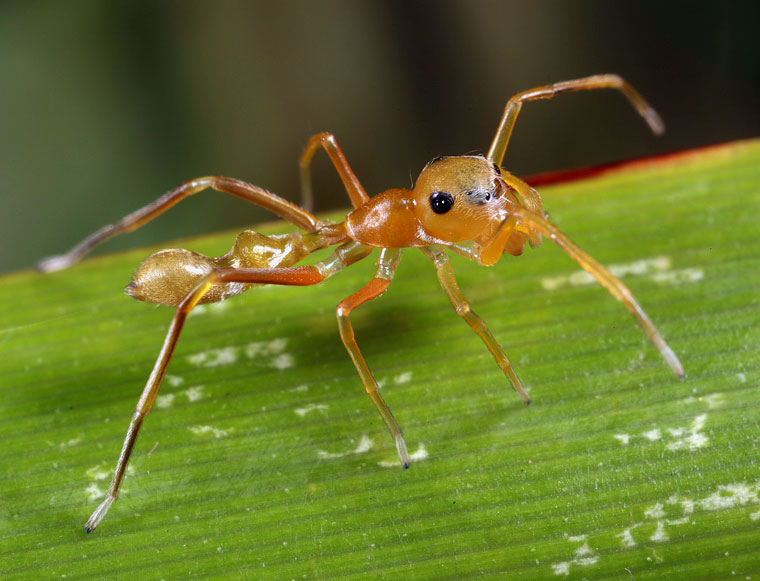
Myrmarachne Merotai (非本實驗中用種類)
標題:Locomotory mimicry in ant-like spiders

摘要

The jumping spider genus Myrmarachne (Salticidae) consists of over 200 species of morphologically accurate ant mimics, enabling Myrmarachne to evade ant-averse predators that confuse the spiders with ants (Batesian mimicry). A conspicuous but untested trait of Myrmarachne, which is frequently mentioned in the literature, is locomotory mimicry. For these spiders, locomotion that is more ant like than salticid like may be an integral part of the suite of mimetic signals. We quantified the locomotory pattern of several species of non-ant-like salticids, Myrmarachne, and ants from Australia. We found that the locomotion of the mimics generally resembles that of ants, but not of other salticids. To tease out the effects of locomotion from those based on morphology, ant-eating salticids as visual predators were presented with 3D animations of ant-like salticids walking either in ant or in salticid fashion. Ant-eating salticids spent significantly longer looking at the stimulus with ant-like movement and were significantly more likely to visually track and stalk the stimulus with ant-like movement. Overall, our results suggest that there is selection pressure on Myrmarachne for increased resemblance to a model by locomotor mimicry, despite the associated costs when faced with ant-eating predators.

蟻蛛屬 (Myrmarachne,跳蛛科)全世界超過200種,令人驚訝的是精確的擬態各種螞蟻的型態與行為,可能帶給這群跳蛛躲避其他天敵的好處,被認為是一種貝氏擬態。但令人疑惑的是,跳蛛科有另外一群種類是專吃螞蟻的,蟻蛛也可能被其他專吃螞蟻的跳蛛攻擊,這樣擬態螞蟻反而可能承受更大的風險,使得科學家一直想弄清楚這群蟻蛛到底是想怎樣?

雖然以人類的角度來看,蟻蛛看起來像螞蟻,走起來像螞蟻,可是有科學上的證據嗎?意外的不多,大部分是觀察式的證據,因此這篇文章的作者們想透過分析澳洲的蟻蛛與螞蟻的行為比較,還有為了弄清楚行為與型態對擬態的貢獻,也把蟻蛛的3D影像播放給吃螞蟻蜘蛛看,同時藉由科學上的行為分析與捕食者的觀點來分析,蟻蛛到底像不像螞蟻。


實驗中觀察的種類之一,Myrmarachne smaragdina,Darwin, Female
photo from Dr. Greg Anderson

行為的紀錄分為三個類型:非螞蟻型跳蛛(其他跳蛛)、蟻蛛與螞蟻的行為模式,分析蟻蛛的行為究竟比較偏向普通的跳蛛,還是比較類似於螞蟻。行為的實驗則透過3D動畫建模,做出蟻蛛的型態,但行為分別是螞蟻與普通跳蛛的動畫,然後播放給吃螞蟻的跳蛛看(給蜘蛛看卡通的意思),分析蟻蛛究竟是透過行為或是型態來欺騙捕食者。

結果顯示蟻蛛的行為的確比較接近螞蟻而非像其他的跳蛛。吃螞蟻的跳蛛花了比較長的時間在螞蟻行為的蟻蛛影像上,顯示即使對捕食者來說,蟻蛛的行為也非常像螞蟻。因此總和來說,雖然偶爾可能面對來自吃螞蟻的蜘蛛的風險,蟻蛛的確受到某些未知的天擇壓力,迫使這樣精確擬態螞蟻的型態與行為留存。
Wrote by Chia-Hsuan Wei
Older Posts Home

FB專頁

熱門文章

  • [科普]自然界中的詐騙集團:生物間「擬態」現象的奧祕
  • [Review] 警戒色與擬態的多樣性之演化:關於多態型、移動平衡與種化
  • 放棄身為跳蛛的堅持:除了型態之外,蟻蛛的動作也像螞蟻嗎?

精選文章

貓頭鷹蝶的眼紋真的擬態貓頭鷹的眼睛嗎?

相關網站

  • Heliconius Homepage
    Michel Cast sent me pictures of this nice hybrid specimen from Ceara, Brazil! Thank you Michel and P. Jauffret!
  • 這是什麼啊? 可以吃嗎?
    最近出現一個被狂轉的新聞,大意是說有人為了避免蝸牛被路殺所以在其殼上彩繪,希望這樣就能讓人類注意到蝸牛的存在而不要把牠們踩死。這聽起來好像立意不錯喔? 但就我們研究警戒與擬態的角度來說,我們認為這種作法天真且有些荒謬,為什麼呢? - 在偽裝(camouflage)與警戒(aposematism)形成...
  • WELCOME TO THE BIODIVERSITY LAB! | Biodiversity Lab
  • Kronforst Lab at the University of Chicago
  • mallet lab
  • MimeticButterflies
  • Mathieu Joron - Home
  • Evolution of predator-prey interactions — Bio- ja ympäristötieteiden laitos

文章類型

  • 文章 (Article) 113
  • 擬態環 (mimicry ring) 12
  • 回顧 (review) 10
  • 科普 4
  • 擬態那些事 3
  • 書 (Book) 3
  • 評論 (comment) 1

研究領域

  • 貝氏擬態 (Batesian mimicry) (43)
  • 警戒性 (Aposematism) (40)
  • 穆氏擬態 (Müllerian mimicry) (37)
  • 多態型 (polymorphism) (16)
  • 擬態環 (mimicry ring) (12)
  • 侵略型擬態 (aggressive mimicry) (10)
  • 隱蔽性 (crypsis) (10)
  • 不完美擬態 (imperfect mimicry) (6)
  • 種化 (speciation) (5)
  • 雌性擬態 (female-limited mimicry) (5)
  • 性擇 (sexual selection) (4)
  • 鳥蛋寄生 (egg parasite) (4)
  • 眼斑 (eyespot) (3)
  • 假頭 (false head) (2)
  • 性雙型性 (sexual dimorphism) (2)
  • 擬蟻性 (Myrmecomorphomania) (2)
  • 機動性擬態 (locomotory mimicry) (2)
  • "模糊"型擬態 (satyric mimicry) (1)

研究方式

  • 行為學 (Ethology) (46)
  • 生態 (Ecology) (21)
  • 系統發生學 (phylogenetics) (16)
  • 基因體 (Genomics) (12)
  • 視覺模型 (visual model) (10)
  • 模擬(modelling and simulation) (6)
  • 遺傳學 (genetics) (6)
  • 族群遺傳 (population genetics) (5)
  • 分子生物學 (Molecular biology) (4)
  • 化學生態 (Chemical ecology) (3)
  • 分子鑑定 (molecular identificaiton) (1)
  • 古生物學 (palaeontology) (1)
  • 地理資訊系統 (GIS) (1)
  • 演化發育學 (Evo-Devo) (1)

分類群

Copyright © 2015 擬態生物學. Designed by OddThemes | Distributed By Gooyaabi Templates