• 首頁 (Home)
  • 理論介紹 (Theories)
    • 警戒色
    • 貝氏擬態 (Batesian mimicry)
    • 穆氏擬態 (Mullerian mimicry)
    • 副貝氏擬態 (quasi-Batesian mimicry)
  • 研究團隊 (research teams)
    • Candy Rowe
    • James Mallet
    • John skelhorn
  • 文獻蒐集 (Bibliography)
    • 2010-
      • 2016
      • 2015
      • 2014
      • 2013
      • 2012
      • 2011
      • 2010
    • 2000-2009
      • 2009
      • 2008
      • 2007
      • 2006
      • 2005
      • 2004
      • 2003
      • 2002
      • 2001
      • 2000
    • More than 650 references on mimicry

擬態生物學

警戒色與擬態的介紹團隊,學術文章導讀,歷史背景,物種,與生物多樣性

Fig. 1 箭毒蛙的親緣關係與將各種特徵映象至樹上,以推測其演趨勢
標題:Aposematism increases acoustic diversification and speciation in poison frogs.
摘要

Multimodal signals facilitate communication with conspecifics during court- ship, but they can also alert eavesdropper predators. Hence, signallers face two pressures: enticing partners to mate and avoiding detection by enemies. Undefended organisms with limited escape abilities are expected to mini- mize predator recognition over mate attraction by limiting or modifying their signalling. Alternatively, organisms with anti-predator mechanisms such as aposematism (i.e. unprofitability signalled by warning cues) might elaborate mating signals as a consequence of reduced predation.We hypoth- esize that calls diversified in association with aposematism. To test this, we assembled a large acoustic signal database for a diurnal lineage of apose- matic and cryptic/non-defended taxa, the poison frogs. First, we showed that aposematic and non-aposematic species share similar extinction rates, and aposematic lineages diversify more and rarely revert to the non- aposematic phenotype. We then characterized mating calls based on morphological (spectral), behavioural/physiological (temporal) and environmental traits. Of these, only spectral and temporal features were associated with aposematism. We propose that with the evolution of anti- predator defences, reduced predation facilitated the diversification of vocal signals, which then became elaborated or showy via sexual selection.

一個物種身上的特徵變化的主力不外乎天擇與性擇,但是有時候我們觀察一個特徵,或許能很輕易的說出「就是為了躲避天敵」或是「就是為了求偶」,但常常忽略兩股力量間的拉扯,譬如雄孔雀的羽毛為了求偶擁有極度漂亮的羽毛與誇張的展示行為,但相對的被天敵發現的機會就提高,而且逃脫能力也降低了,這樣的性狀就會在兩股力量間有個權衡(trade-off),以得到利益的最大值。另一個角度來看,一個物種如果有警戒性,意即本身不需要接受太多來自天敵的壓力,這個物種用來求偶的行為會不會比起要躲避天敵的物種來的誇張呢?這對於性擇與種化又有什麼影響?

這篇研究的作者群以12S-16S rDNA建構172種箭毒蛙的親緣關係,測試警戒性與隱蔽性求偶行為與種化的演化趨勢。作者群假設隱蔽的物種透過另外發展比較低調的方式求偶,而比較警戒的物種可能將求偶的行為與警戒性結合,呈現越警戒越有求偶優勢的趨勢。透過一連串的形質測量,包含測試體表的光學反射評估隱蔽與警戒性,蒐集16657筆青蛙的求偶叫聲並將其分類以及比較體表植物鹼的分泌能力等,再將這些資料綜合進行一連串的分析,用以推測作者群的假設。

Fig. 2 箭毒蛙的種化分析
Fig. 3 系統發生學上對植物鹼的分泌與顯眼度的回歸分析
最主要的結果如最上圖。首先,作者群發現無論是警戒的或隱蔽的物種,其物種滅絕率是相似的,但出現警戒性的支系分化出的物種多樣性比較高,而且顯少出現返回到非警戒性特徵的趨勢。將求偶叫聲以型態(光學形質)、行為/生理(時間相關形質)與環境特徵作分類的話,發現光學與時間相關形質與警戒性有關。這顯示為了抵抗捕食者演化出來的特徵,也促進聲音利用的演化,進而成為影響性擇與種化。(本研究做了非常多的分析,細節請參閱內文)


Wrote by Chia-Hsuan Wei
小丑箭毒蛙 (Oophaga granulifera)紅色型
photo: ARKive


標題:NOT EVERYTHING IS BLACK AND WHITE: COLOR AND BEHAVIORAL VARIATION REVEAL A CONTINUUM BETWEEN CRYPTIC AND APOSEMATIC STRATEGIES IN A POLYMORPHIC POISON FROG

摘要

Aposematism and crypsis are often viewed as two extremes of a continuum of visual conspicuousness to predators. Theory predicts that behavioral and coloration conspicuousness should vary in tandem along the conspicuousness spectrum for antipredator strategies to be effective. Here we used visual modeling of contrast and behavioral observations to examine the conspicuousness of four populations of the granular poison frog, Oophaga granulifera, which exhibits almost continuous variation in dorsal color. The patterns of geographic variation in color, visual contrast, and behavior support a gradient of overall conspicuousness along the distribution of O. granulifera. Red and green populations, at the extremes of the color distribution, differ in all elements of color, contrast, and behavior, strongly reflecting aposematic and cryptic strategies. However, there is no smooth cline in any elements of behavior or coloration between the two extremes. Instead populations of intermediate colors attain intermediate conspicuousness by displaying different combinations of aposematic and cryptic traits. We argue that coloration divergence among populations may be linked to the evolution of a gradient of strategies to balance the costs of detection by predators and the benefits of learned aversion.

小丑箭毒蛙(箭頭青蛙、細疣箭毒蛙,Oophaga granulifera)也是一種隨區域顏色不相似的箭毒蛙,其族群間體色的變化十分劇烈,從醒目的紅色到看起來不太顯眼的綠色都能找的到,奇妙的是箭毒蛙本身應該是透過醒目的顏色來警告捕食者的種類,那麼不太顯眼的綠色代表的是另一種警戒色,或是暗示這個物種的不同族群採用的顏色策略不一樣?

Fig. 1 本篇研究採用的四個族群分佈
photo: National Geographic
作者群討論哥斯大黎加西方低地小丑箭毒蛙的的體色變異(如上圖),選定四個區域的族群,以量測背面八處(頭部兩處,背部六處)與腹面八處(胸部兩處,腹部六處)的反射光譜,以及六種不同的環境基質(樹皮、岩石、綠葉、落葉、香蕉樹、泥土),比較顯眼的程度,並且將個體的光譜資訊套用藍山雀的視覺模型,模擬捕食者的視覺型態。另一方面透過行為的觀察,比較從顯眼到不顯眼的個體是否存在不同程度的行為差異。

光譜測量的結果顯示從紅色到綠色族群存在漸進式的差異。紅色與綠色的族群間,不論是顏色、對比或行為都呈現顯著的差異,顯示兩個族群的顏色分別反應警戒與隱蔽兩種不同的策略(綠色的族群明顯的叫聲較少,捕食率也較低)。雖然如此,但這看似漸進式的顏色變化,其實反應的是中間型個體的顏色是透過不同身體部分的顏色組合來呈現,而非單純的只是皮膚顏色的變化。

Fig. 2 光譜反射與彩度分析結果,A與B是背部,C與D是腹部。
這些證據顯示即使是有防禦的物種,還是有可能透過不醒目的顏色採取隱蔽的策略,而這與當地的捕食者結構是否有因果關係(太聰明?視覺模式有很大的差異?再毒也吃的下去的物種?),未來的類似討論勢必需要更多的捕食者資訊,而非反覆透過特定數種「模式物種」,狹隘的驗證有多重變因的現象。
Wrote by Chia-Hsuan Wei
精靈箭毒蛙各區域型態與分佈
photo: Ranitomeya imitator (wiki)/nl


標題:Alkaloid defenses of co-mimics in a putative Müllerian mimetic radiation

摘要

Background: Polytypism in aposematic species is unlikely according to theory, but commonly seen in nature. Ranitomeya imitator is a poison frog species exhibiting polytypic mimicry of three congeneric model species (R. fantastica, R. summersi, and two morphs of R. variabilis) across four allopatric populations (a "mimetic radiation"). In order to investigate chemical defenses in this system, a key prediction of Müllerian mimicry, we analyzed the alkaloids of both models and mimics from four allopatric populations.

Results: In this study we demonstrate distinct differences in alkaloid profiles between co-mimetic species within allopatric populations. We further demonstrate that R. imitator has a greater number of distinct alkaloid types than the model species and more total alkaloids in all but one population.

Conclusions: Given that R. imitator is the more abundant species in these populations, R. imitator is likely driving the majority of predator-learned avoidance in these complexes. The success of Ranitomeya imitator as a putative advergent mimic may be a direct result of differences in alkaloid sequestration. Furthermore, we propose that automimicry within co-mimetic species is an important avenue of research.


如果擬態的關係裡有個物種扮演的是擬態模型(model)的角色,我們會預期這個物種要比較多、比較毒,簡而言之就是比較能忠實的反應代表牠的警戒性,如此才能有效率的警告或教訓捕食者,讓這個警戒特徵的獲益度提高。問題在於,我們知道模型要比較毒,但怎麼知道模型真的比較毒?有多毒?真的比擬態者(mimic)毒嗎?透過捕食者的反應是個管道,但間接的透過另一個物種終究比較有難度,有沒有什麼直接測量的方法呢?

Fig. 1 作者取樣的族群

精靈箭毒蛙(Ranitomeya imitator)是個多態型的物種,分佈於新熱帶區的核心地帶,也是參與穆氏擬態的一員,各個不同族群參與或帶領不同的擬態群。作者群透過直接測量精靈箭毒蛙的防禦性化學物質,也就是植物鹼 (alkaloid),推測精靈箭毒蛙有沒有可能是各族群穆氏擬態斑紋的領頭羊,如果是的話,結果應該反應精靈箭毒蛙相對數量比較多,而且比較毒。

作者群採用的方法是直接分析其難吃的源頭:生物鹼化合物的性質。他們用化學的方式直接定性與定量生物鹼的種類與數量,比較各族群的模型與擬態者的差異。作者群假設生物鹼的種類越多就越難吃,含量越高也越難吃。

Fig. 2 各族群的植物鹼組成相似度分析,顯示植物鹼種類在族群間有差異

結果顯示各地族群的植物鹼組成顯著有差異。精靈箭毒蛙除了在Varadero這個地方的族群植物鹼含量少於其擬態者 ,R. fantastica,其他的指標:族群數量,以及植物鹼種類與含量都是精靈箭毒蛙比較高。精靈箭毒蛙在這兩個指標上符合擬態模型的前提,代表牠比較有機會「教育」當地捕食者,基於這個機制,有可能帶領各地區斑紋的演化。

Fig. 3 各地族群的植物鹼種類數比較,精靈箭毒蛙的種類都比較多

Fig. 4 各地族群的植物鹼含量。除了Varadero外,精靈箭毒蛙體內的植物鹼含量較高。


這個研究告訴我們,用化學生態的方法直接呈現某些指標數據,可以解答物種在擬態中所扮演的生態角色,但直接測定植物鹼實在是有難度的一件事,只能看未來有沒有更多的柯學家有興趣解答其他的擬態群。(簡單的說,又是藍海)


Wrote by Chia-Hsuan Wei
photo from Bgreenproject
標題:An Analysis of Predator Selection to Affect Aposematic Coloration in a Poison Frog Species

摘要

Natural selection is widely noted to drive divergence of phenotypic traits. Predation pressure can facilitate morphological divergence, for example the evolution of both cryptic and conspicuous coloration in animals. In this context Dendrobatid frogs have been used to study evolutionary forces inducing diversity in protective coloration. The polytypic straw- berry poison frog (Oophaga pumilio) shows strong divergence in aposematic coloration among populations. To investigate whether predation pressure is important for color divergence among populations of O. pumilio we selected four mainland populations and two island populations from Costa Rica and Panama. Spectrometric measurements of body coloration were used to calculate color and brightness contrasts of frogs as an indicator of conspicuousness for the visual systems of several potential predators (avian, crab and snake) and a conspecific observer. Additionally, we conducted experiments using clay model frogs of different coloration to investigate whether the local coloration of frogs is better protected than non-local color morphs, and if predator communities vary among populations. Overall predation risk differed strongly among populations and interestingly was higher on the two island populations. Imprints on clay models indicated that birds are the main predators while attacks of other predators were rare. Furthermore, clay models of local coloration were equally likely to be attacked as those of non-local coloration. Overall conspicuousness (and brightness contrast) of local frogs was positively correlated with attack rates by birds across populations. Together with results from earlier studies we conclude that conspicuousness honestly indicates toxicity to avian predators. The different coloration patterns among populations of strawberry poison frogs in combination with behavior and toxicity might integrate into equally efficient anti-predator strategies depending on local predation and other ecological factors.

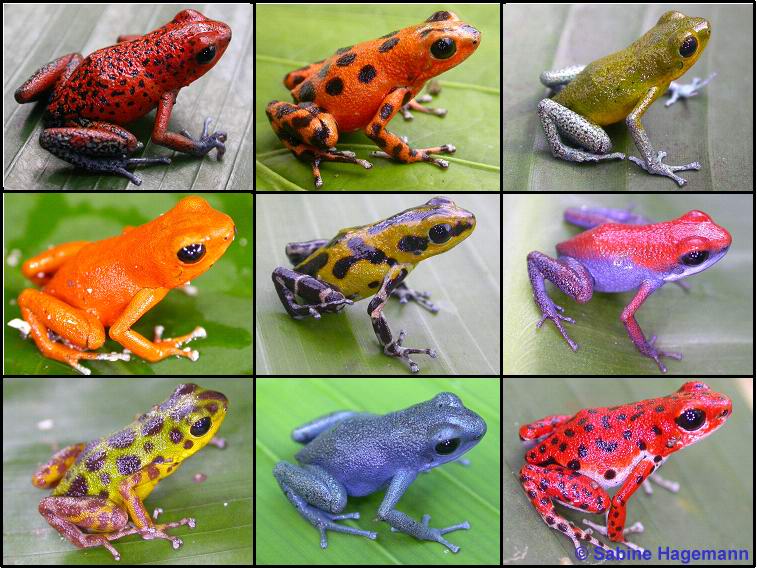
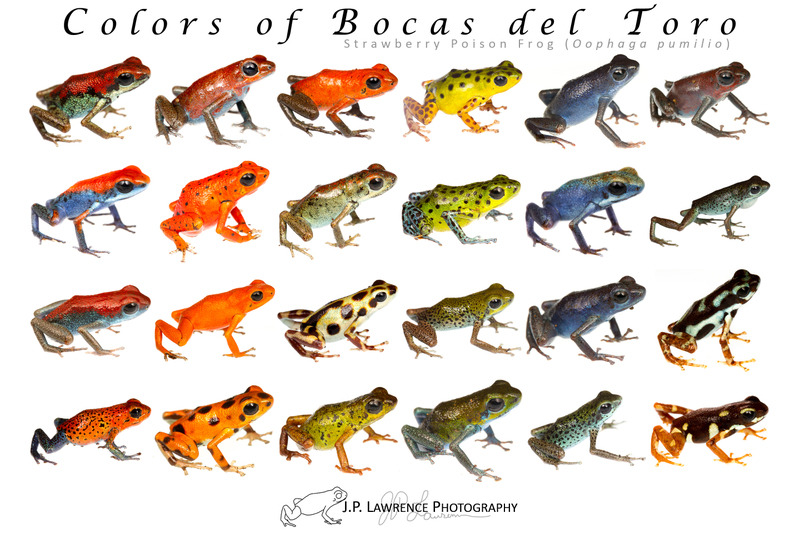
草莓箭毒蛙(Oophaga pumilio)是個不同族群長的不一樣的多態性物種,而且每個族群呈現不同的警戒性。這樣的現象通常引起科學家的興趣,因為這可能代表背後不同的選汰力量,也牽涉到潛在的種化趨勢,這些難解的問題到底來自天擇,還是來自性擇,還是來自其他未知的力量?

不同族群在不同視覺模型下的相對亮度與相對顏色
photo from Fig. 1
這篇文章的作者想測試草莓箭毒蛙的多態性是不是來自天擇(捕食者)的選擇,他們選擇在哥斯大黎加與巴拿馬附近,四個大陸上的與兩個島嶼上族群來調查。測試分成兩個部分,一個部分是分別測量不同族群個體背面與腹面的反射光譜,然後套用鳥類、螃蟹與蛇的視覺模型,判斷哪些可能是潛在捕食者;另一個部分作者製作四個顏色的黏土模型(紅、黃、綠、藍),然後分別放了400隻模型,分了四次放到自然環境中,每個族群總共放1600隻黏土模型測試被攻擊次數。如果有攻擊的話,可以分為鳥(U或V型)、老鼠、蛇、蜥蜴、與未知的捕食標記。

不同族群的被攻擊數,灰色來自鳥類,黑色來自其他攻擊
photo from Fig. 2
綜合6個族群,不同顏色的被攻擊數
photo from Fig. 3

反射光譜的部分各有千秋,細節詳見內文。整體來說背部紅/橘與黃色的族群的顯眼度整體高於藍色與綠色,腹部的顯眼度基本上沒有差異,但Isla Colon的腹部黃色比起Isla Solarte的顯眼度差不多或稍高。捕食實驗的結果每個族群各有差異,兩個島嶼族群的被攻擊數比較高,然而如同當地顏色的黏土模型的被攻擊數與非當地顏色的沒有差異。整體來說大部分的攻擊都來自鳥類,來自其他的攻擊顯著的比起鳥類少很多。綜合這個研究與之前的研究,不同顏色的不同族群忠實的反應其毒性。儘管毒性有所不同,但配合不同的行為調整,可能可以讓不同族群的防禦效益,讓族群間的「防禦值」達到同樣的水準,反應不同的捕食壓力與其他的生態因子。

這個文章整體看起來,捕食者對多態型的形成主要的壓力是來自鳥類,然而細緻的型態演化本篇沒有多著墨,大概還是跟不同種的鳥類認知與細膩的演化有關。總和近期的文章來看,捕食者到底認得什麼似乎是個重要的關鍵,或許這些作者可以考慮使用3D列印,真正印出類似的斑紋,替代單純的只使用顏色分類的模型,可能可以比較反應真實的情況。
Wrote by Chia-Hsuan Wei
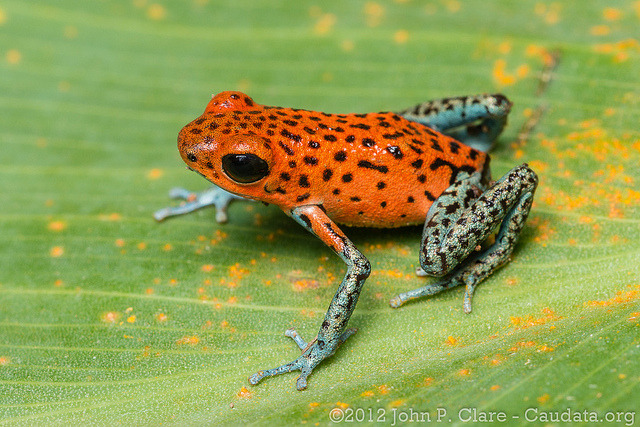
草莓箭毒蛙 (Oophaga pumilio)
photo from Strawberry poison-dart frog (wiki)
草莓箭毒蛙較黯淡個體
photo from Terraria
標題:A multifunctional warning signal behaves as an agonistic status signal in a poison frog.

摘要

Aposematic species use conspicuous “warning” signals to communicate unprofitability to potential predators. Although warning signals are classic examples of communication systems that evolved by natural selection, they can also function in the context of sexual communication and are therefore particularly useful for investigating conspicuous trait evolution under multifarious selection. To test whether aposematic signals also serve to mediate intrasexual disputes, we observed males from a highly territorial poison frog species (Oophaga pumilio) in their native territories and in experimental dyadic contests to assess the influences of body characteristics such as warning signal brightness and body size on the outcomes of territorial interactions. We report here that although neither male size (snout–vent length) nor mass significantly predicted male aggressiveness (latency to call) in dyadic contests, a male’s dorsal brightness was a significant predictor of willingness to initiate aggressive interactions, with brighter males exhibiting a shorter latency to call than duller males. Furthermore, brightness asymmetries between males predicted the outcomes of contests such that asymmetries were smaller in escalated aggression trials (where both males called), and brighter males were more likely to be the sole aggressor in trials with large asymmetries. These tests, combined with previous work, provide evidence that warning coloration has been co-opted as an agonistic indicator trait in this aposematic amphibian and reveal the potential evolutionary lability of conspicuous traits that arise through natural selection.

一般來說,生物的警戒性(aposematism)是被認為向捕食者傳遞視覺訊號,以降低被捕食的機制。不過從一些例子來看(例如毒蝶),這些看起來非常顯眼的斑紋除了傳給捕食者外,可以傳給同種的個體,也可以是給異性的視覺訊號,刺激某種擇偶偏好,這些斑紋就顯現出不止一種功能。

草莓箭毒蛙 (Oophaga pumilio) 是一個多態型的物種,從很明亮到比較陰暗的體色都有。這種箭毒蛙的雄性有非常強的領域性,那麼這篇文章的作者就想到:這麼明亮的斑紋,會不會在雄性上代表什麼呢?比較強還是比較弱呢?佔領域上會不會有優勢呢?會不會對其他雄性比較兇呢?

上為3D列印的模型與反射光譜,下為播放器放的蛙叫聲譜
photo from Fig. 1
作者從野外找了110隻雄性的個體,抓到後立刻量測身體資訊(吻肛長與體重),然後像鬥蟋蟀一樣,把110隻雄性個體分成55組配對,分別放進一個實驗用的競技場(61x20x20 cm)裡,放置15分鐘後讓兩隻互看,紀錄是否有侵略性行為,如延遲呼叫的時間與起始呼叫的時間。另一個部分測試身體的亮度是否誘發領域行為,作者用3D列印的模型(見上圖)配合播放器,在野外「挑釁」雄性個體,然後蒐集雄性的叫聲,或是觀察是否接觸模型或是對著播放器叫。

雄性叫聲延遲與體色、體長與體重的關係
photo from Fig. 2
雄性間的「比試」是否增強與個體體色、體長、體重的不平衡度的關係
photo from Fig. 4
結果發現雄性的侵略性與吻肛長或體重都沒顯著的關係,而身體的亮度較亮的個體比起較暗的個體的叫聲延遲更短。另一方面,當兩者間的亮度不平衡度越大的時候,雄性個體更容易的產生侵略性的行為,而體色比較明亮的個體可能單獨侵略其他個體。綜合整個結果,看起來越明亮的個體越具有侵略性,這樣的警戒性除了藉由天擇留下更明亮的顏色外,也可能透過種內同性的競爭反應更大的性擇優勢。

越來越多的研究證據支持警戒色/擬態物種的體色已經不如以往想得這麼簡單,也說明生物演化出一個特徵,通常不會只為了一個用途,必然受到多樣化的天擇/性擇等各方壓力,才能將這些特徵留存下來,若一有不適合,很快就可能產生變化(註:這個「很快」是萬年起跳)。
Wrote by Chia-Hsuan Wei
photo from content
a)表示精靈箭毒蛙 (R. imitator)
b) 表示其model 皇冠箭毒蛙 (R. fantastica) 與 齊亞曼箭毒蛙 (R. variabilis)
c) 兩型的分佈與雜交帶是意圖
d) 雜交帶出現的精靈箭毒蛙的多態型
e) 研究區域

標題:Reproductive isolation related to mimetic divergence in the poison frog Ranitomeya imitator

摘要

In a mimetic radiation—when a single species evolves to resemble different model species—mimicry can drive within-species morphological diversification, and, potentially, speciation. While mimetic radiations have occurred in a variety of taxa, their role in speciation remains poorly understood. We study the Peruvian poison frog Ranitomeya imitator, a species that has undergone a mimetic radiation into four distinct morphs. Using a combination of colour–pattern analysis, landscape genetics and mate-choice experiments, we show that a mimetic shift in R. imitator is associated with a narrow phenotypic transition zone, neutral genetic divergence and assortative mating, suggesting that divergent selection to resemble different model species has led to a breakdown in gene flow between these two populations. These results extend the effects of mimicry on speciation into a vertebrate system and characterize an early stage of speciation where reproductive isolation between mimetic morphs is incomplete but evident.

photo from content
各種不同參數的比較結果


討論擬態、種化與族群遺傳研究目前只有毒蝶 (Heliconius)比較多,精靈箭毒蛙的例子與毒蝶的例子很相似,不同區域擬態不同的物種,但對於不同族群間的遺傳結構,基因有沒有在族群間交流還不清楚。這個研究透過比較各種參數,像是微衛星體、身體的顏色與樣式、雄性的體重等等,顯示這個族群間只有很狹隘的雜交帶,各族群間已經有十分顯著的差異。這跟毒蝶的例子相似,可能是一個因為擬態的斑紋侷限族群的分佈,進而產生地理隔離種化的例子。


photo from content
此圖說明不同擬態型的精靈箭毒蛙的遺傳結構
這樣的研究與毒蝶最大的差異就在於這是脊椎動物,對於演化歷程完全不同的兩個擬態系統來說,如果能找類似的作用機制,是不是就能替擬態在自然界的作用找到個通論了呢?相似的系統還有很多,期待未來的發展。
Wrote by Chia-Hsuan Wei
photo from Ecuatoria: Dendrobatids

標題:Number of genes controlling a quantitative trait in a hybrid zone of the aposematic frog Ranitomeya imitator

摘要

The number of genes controlling mimetic traits has been a topic of much research and discussion. In this paper, we examine a mimetic, dendrobatid frog Ranitomeya imitator, which harbours extensive phenotypic variation with multiple mimetic morphs, not unlike the celebrated Heliconius system. However, the genetic basis for this polymorphism is unknown, and not easy to determine using standard experimental approaches, for this hard-to-breed species. To circumvent this problem,we first develop a newprotocol for automatic quantification of complex colour pattern phenotypes from images. Using this method, which has the potential to be applied in many other systems, we define a phenotype associated with differences in colour pattern between different mimetic morphs. We then proceed to develop a maxi- mum-likelihood method for estimating the number of genes affecting a quantitative trait segregating in a hybrid zone. This method takes advantage of estimates of admixture proportions obtained using genetic data, such as microsatellite markers, and is applicable to any other system where a phenotype has been quantified in an admixture/introgression zone. We evaluate the method using extensive simulations and apply it to the R. imitator system. We show that probably one or two, or at most three genes, control the mimetic phenotype segregating in a R. imitator hybrid zone identified using image analyses.

photo from content

用來研究擬態系統的分類群中,除了毒蝶 (Heliconius)目前有系統的從生態到基因體,很少有例子能夠做到這種程度,主要是因為毒蝶好抓好生好養,可以容易的透過孟德爾式遺傳的方式找出性狀的變化,進而推估控制斑紋的基因數量、是否聯會(linkage)等遺傳上的資訊。很多其他的生物沒辦法做到這樣的研究,就是因為數量少難生難養,或是生活史世代太長,沒辦法進一步的探索這些資訊,進而推估背後的演化來源等等相關理論。

但科學家總是有辦法的。精靈箭毒蛙 (Ranitomeya imitator)是一種有多態性的物種,像毒蝶一樣,每一個不同區域的樣式都擬態當地的model,但箭毒蛙就是一個難生難養,難以取得大量子代的物種,這個研究就假設「如果一個基因控制能控制一種變異,那麼從透過分析表型的變異程度,應該可以知道到底有幾個基因控制這些表型」。作者透過把高解析度的照片弄成如上圖展示擬態的樣式,透過文中所寫的likelihood model,配上一些微衛星體的分子資料的比較,模擬究竟有幾種基因牽涉其中。

photo from content
模擬的結果顯示看起來是兩個,至多三個基因控制這些擬態的斑紋。這個方式有很多好處:

1) 只要透過照片就能分析,不需大量採集野外個體
2) 省去飼養的時間
3) 不需要花大錢全基因體定序就能有結果

這種模擬的結果,有點類似前測試,或是只能知道虛無假說的方向,提供一個推估同樣難生難養的分類群的遺傳資訊的方法,可是基因實際上有幾個,分佈在哪些染色體上,是否形成超基因 (supergene) ,對於演化的歷程有沒有影響,是無法從這個方法得知的。


Wrote by Chia-Hsuan Wei

photo from J. P. Lawrence

標題:Colour and Escape Behaviour in Polymorphic Populations of an Aposematic Poison Frog [pdf]

摘要

The phenomenon of aposematism, or the pairing of antipredator defence with conspicuous or distinctive signals, serves as an excellent example of how traits act in concert to shape fitness. Not only does this complex phenotype require the integration of multiple traits, it alters the fitness pay-offs of yet others. The protection offered by aposematism may, for example, reduce the costs associated with foraging or sexual display. Thus, well-protected aposematic lineages should be bolder, more active and less likely to respond to perceived threats of predation than more cryptic lineages. Comparisons of differently coloured morphs of the poly-typic strawberry poison frog (Oophaga pumilio) have supported the predicted behavioural correlates of aposematism, with the exception of those regarding responsiveness to simulated predators. We tested the key prediction that aposematic coloration will be associated with reduced sensitivity to predators in two polymorphic O. pumilio populations. The novel approach of studying polymorphic populations allowed us to assess the effect of colour in the absence of potentially confounding habitat differences. We found that colour was associated with the probability that a frog would attempt escape and the distance at which it fled, but only in one population, and not in the predicted direction. An overall comparison of the two populations superficially supported our predictions, but this pattern actually arose because frogs occupying higher perches were less likely to respond, a pattern that may reflect the value of high perches and the costs associated with returning to them after attempted escape. These results highlight the complexity of the relationship between predators and prey, the challenges associated with understanding how and why traits are correlated, and the intimate ties between behaviour and morphological evolution.

警戒色是生來嚇阻警告捕食者,告訴牠們「我不好吃別吃我」的視覺訊號,這對擁有警戒色的物種的好處是避免被攻擊與提高生存率。既然如此,是不是就代表這些物種在外出覓食或是求偶的時候,可以花費比較少的能量躲避捕食者呢?(就是我夠兇不用躲的意思)

這個研究用草莓箭毒蛙 (Oophaga pumilio)做為研究對象,草莓箭毒蛙本身就是具有多態性的物種,從看起來警戒到看起來隱蔽的樣式都有,因此可以降低不同種間遺傳結構所產生的行為差異,很適合做為討論這個問題的標的物種。作者選定兩個地方的族群 Isla Bsastimentos與Dolphin bay (都在巴拿馬),作者實際到這兩處的雨林中蒐集資料,透過穿越線的方式找尋野生的個體,然後以人類做為捕食者慢慢靠近的方式進行實驗。首先選定兩個類型的體色:有警戒色的與比較黯淡的,評估族群間是否有體色上的差異(沒差,有差就不用做了),接著評估兩種行為1) 個體看到捕食者時是否企圖要逃跑 2) 捕食者與個體開始逃跑間的最短距離 (flight initiation distance, FID)。結果顯示兩個區域間企圖逃跑的比例不一樣,在Bastimentos的族群有企圖逃跑行為的比Dolphin Bay的要少,如果與顏色有關的話,那麼兩者間的比例應該會很接近,這邊顯示只有其中一個族群反應作者的假說。另一個分析顯示這些個體要不要討跑與所停的高度(perch height)比較有關,與作者的假說相關度比較低,顯示停棲高度可能與對能不能發現捕食者,進而引發逃跑反應比較有影響。

flight initiation distance (FID) wiki

其實這個研究的前提有點弔詭,如果一個物種有防禦+有亮眼的顏色=警戒性,那麼有防禦+黯淡的顏色就不等於警戒性了嗎?因為個體還是有毒,因此這個「黯淡的顏色」還是有可能被天敵當成某種避忌訊號,只是以人類的視覺角度來看的話,就會變成沒有要不要逃跑取決於其他因子而不是因為有沒有警戒色。
Wrote by Chia-Hsuan Wei
(copyright: Twomey et al. 2015)

標題:Mimetic Divergence and the Speciation Continuum in the Mimic Poison Frog Ranitomeya imitator

摘要 [原文]

While divergent ecological adaptation can drive speciation, understanding the factors that facilitate or constrain this process remains a major goal in speciation research. Here, we study two mimetic transition zones in the poison frog Ranitomeya imitator, a species that has undergone a Müllerian mimetic radiation to establish four morphs in Peru. We find that mimetic morphs are strongly phenotypically differentiated, producing geographic clines with varying widths. However, distinct morphs show little neutral genetic divergence, and landscape genetic analyses implicate isolation by distance as the primary determinant of among-population genetic differentiation. Mate choice experiments suggest random mating at the transition zones, although certain allopatric populations show a preference for their own morph. We present evidence that this preference may be mediated by color pattern specifically. These results contrast with an earlier study of a third transition zone, in which a mimetic shift was associated with reproductive isolation. Overall, our results suggest that the three known mimetic transition zones in R. imitator reflect a speciation continuum, which we have characterized at the geographic, phenotypic, behavioral, and genetic levels. We discuss possible explanations for variable progress toward speciation, suggesting that multifarious selection on both mimetic color pattern and body size may be responsible for generating reproductive isolation.


簡單的說一下這個故事的來由。

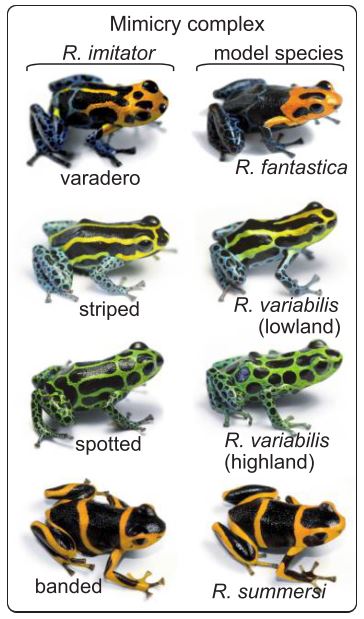
圖中左列的這個蛙蛙是個分佈在秘魯的一種箭毒蛙,中文名稱叫精靈箭毒蛙,這個蛙蛙很神奇的是個多態型,分別擬態右列四個位於不同棲地的物種,剛好這四個物種都在秘魯,而且剛好這四個物種都分佈在附近,這蛙蛙又剛好擬態這四個都在附近的物種。

這一切都這麼剛好不拿來做點什麼實在太可惜了。

所以什麼族群遺傳、野外調查、多態型分佈、雜交帶、選偶偏好之類的,想的到的可以做的其實都做了,現在的問題就在於:這樣的擬態型態分化會不會帶動種化?

於是這篇文章對於幾個不同型的雜交帶分別調查了中間型地理分佈的距離,族群是否基因交流,不同型態族群間的雄性是否有擇偶偏好等等。

在這裡我先說明,如果有種化現象的話,這些預期應該是中間型地理分佈的距離(也就是雜交帶)的空間應該很狹窄,族群間基因交流與滲漏的數值很低,雄性應該偏好選擇與自己相似的雌性,如此才有可能帶動種化。

結果說明中間型的地理分佈不一,從幾十公里到一百公里都有;族群間的基因交流值非常高;在雜交帶的雄性沒有偏好,可是在某些型態分佈中心的雄性有顯著的偏好。

結論上來說就是該有的都沒有,但這文章就抓了這點「在雜交帶的雄性沒有偏好,可是在某些型態分佈中心的雄性有顯著的偏好」來說明這是強烈的證據支持這族群正在連續性種化(speciation continuum)的開端,整篇文章唯一正面的證據就只有這個,其他大部分都只部分支持或看不出來族群間有明顯的分化,而且全文脈絡感覺就是為了要解釋這個現象而寫的,儘管只有一小部分的證據支持這現象。

所以各位同學看到了嗎,就算你的樹都沒解析度,族群都沒分化,但只要符合某些假設,你也可以說這就是種化的開端喔!

至於連續性種話這說下去太複雜了,有需求的話再看看要不要寫一篇來解釋一下。


Wrote by Chia-Hsuan Wei
圖片來源:本文章

原文標題:Sexual dimorphism and intra-populational colour pattern variation in the aposematic frog Dendrobates tinctorius

摘要 [原文網址]

Despite the predicted purifying role of stabilising selection against variation in warning signals, many aposematic species exhibit high variation in their colour patterns. The maintenance of such variation is not well understood, but it has been suggested to be the result of an interaction between sexual and natural selection. This interaction could also facilitate the evolution of sexual dichromatism. Here we analyse in detail the colour patterns of the poison frog Dendrobates tinctorius and evaluate the possible correlates of the variability in aposematic signals in a natural population. Against the theoretical predictions of aposematism, we found that there is enormous intra-populational variation in colour patterns and that these also differ between the sexes: males have a yellower dorsum and bluer limbs than females. We discuss the possible roles of natural and sexual selection in the maintenance of this sexual dimorphism in coloration and argue that parental care could work synergistically with aposematism to select for yellower males.

先介紹這隻青蛙,這隻D. tinctorius就是市面上所謂的染色箭毒蛙,分布於巴西、法屬圭亞那、蘇利南等地,與有些箭毒蛙一樣具有鮮豔的警戒色,但在不同的族群有不同的體色。

當然,一開始當然要說的是,具有警戒色的物種的多態型是與預測不符合的,因為要有夠強夠集中的衝擊才能讓捕食者知道這是不能吃的,那麼為何這樣的物種還會有多態型或是性雙型性就讓人很好奇了。(相關文章請看Oophaga histrionica與Oophaga pumilio)。

這篇文章看起來算是一個初始調查,調查有幾個型與分佈的關聯性等等,而他們發現族群內的體色變異幅度相當顯著,而且雌雄間也有差異,這群研究者推測這個種之所以可以有多型性,也是因為不管哪個型在光線底下都非常顯眼,也就是都是警戒色,但這部份需要更進一步的實驗才能判斷;另外他們也推測雌蛙在選擇對象時,會優先選擇較黃的雄蛙,因為雄蛙的被捕食率較高,而較黃的雄蛙可能已經避免多次的捕食者攻擊,因此子代較有可能生出同樣類型的體色,會有較高的子代存活率。
Wrote by Chia-Hsuan Wei
圖片來源:http://www.zoomania.org/wp-content/uploads/2013/05/Polymorphismus.jpg

原文標題:Loss of conspicuous coloration has co-evolved with decreased body size in populations of poison dart frogs

摘要 [原文網址]

Larger signal size is known to facilitate the learning process of predators to warning signals. Further, smaller objects are generally harder to detect than large, which suggests that smaller sized prey are less likely to benefit from an aposematic strategy compared to crypsis. However, whether body size changes in concert with shifts between crypsis and aposematism in natural populations, remains largely unexplored. I tested whether body size was larger in visually conspicuous population than in cryptic populations among recently diverged populations of the Strawberry Poison frog, Oophaga pumilio. By analysing spectral reflectance and body size data from individuals from 18 discrete populations I found a larger mean body size in conspicuous populations, which was confirmed by an analysis of a subset of 12 populations accounting for phylogenetic history. This shows that the loss of conspicuous colour likely co-evolved repeatedly with a decrease in body size. Thus, selection on body size may influence evolutionary shifts between aposematism and crypsis and vice versa.

越大的體型,通常越顯眼,越容易被發現,如果搭配顯眼的顏色的話效果會更好,而越小的體型即使是顯眼的顏色,效果或許也不會這麼好。

本篇作者利用這個概念,測量不同族群的草莓箭毒蛙的體型與利用光譜儀測試體表的光反射,得到箭毒蛙的體型與警戒色是有關聯的。越小的體型體色會較不顯眼,而較大的體型顯眼性較高。
Wrote by Chia-Hsuan Wei
圖片來源:http://www.dendrobase.hu/wp-content/uploads/2010/07/OophagaHistrionica018800_mark_aartse-tuyn.jpg

原文標題:Field but not lab paradigms support generalisation by predators of aposematic polymorphic prey: the Oophaga histrionica complex

摘要 [原文網址]

The persistence of novel aposematic forms, and thereby the evolution of aposematic polymorphism, remain intriguing. Novel and rare forms could be disproportionally attacked by predators that already learned to avoid a pre-existing and more common aposematic form. Alternatively, novel forms could be less frequently attacked if predators are reluctant to attack unknown potential prey (neophobia) or if previous learning allows them to generalise and recognise the novel form as toxic. We used colour variation in polymorphic poison frogs (Oophaga histrionica complex) to test whether predators familiar with one aposematic form do generalise their avoidance behaviour to other aposematic forms. To strengthen our inference, we combined a field test of attack rates to local and non-local models with a lab experiment of generalisation capabilities by newly born chicks. Field predators attacked a significantly lower proportion of 529 aposematic compared to 150 cryptic models. Predators co-occurring with the local aposematic form of O. histrionica equally avoided non-local forms, especially in areas where the species was abundant. Forty-two lab chicks learned to discriminate between an aposematic and a cryptic image, but failed to generalise to other aposematic images, even though we tried with six combinations of aposematic forms. To better mimic the situation in the field, we further tested whether chicks trained with a set of four simultaneous aposematic images would generalise better. They failed to learn the discrimination task. Our data contrast with previous field studies on other poison frogs, and support a role for generalisation, and arguably not neophobia, in predator avoidance of novel aposematic forms.


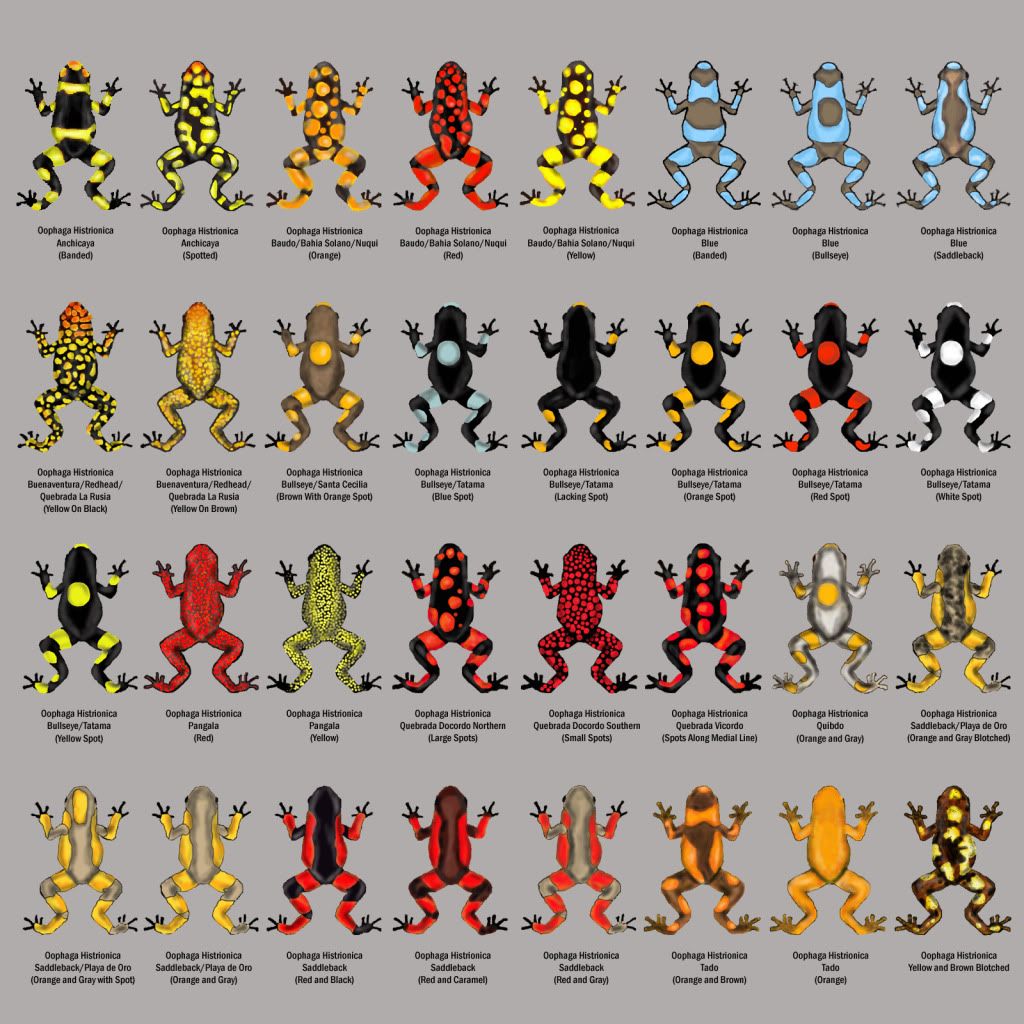
首先介紹這個箭毒蛙,其實我跟牠不熟,但查了以後發現他真的很多型

圖片來源:http://i795.photobucket.com/albums/yy235/frogandtoadarefriends/Dart%20Frogs/HISTRIONICAGUIDE.jpg

如上圖所示,如果這是真的,那麼這個箭毒蛙至少有40個型,那麼一來這是警戒色,二來捕食者會對這樣的獵物有什麼反應呢?

本文同時進行了野外與實驗室的操作,野外的實驗發現相較於隱蔽的模型而言,捕食者的確較少攻擊具有警戒色的模型,而如果把不是這個區域的型放進來測試的話,當地的捕食者也會避免攻擊這樣的獵物,也就是已經將這些型概括化,而這或許是從捕食者自身的經驗變化而來。另一部分在實驗室的實驗,測試剛出生的小雞對這些模型的反應,結果則顯示雖然小雞能夠分辨警戒色與隱蔽色的差異,但是無法將不同的型概括化。

這個文章很有趣的告訴我們幾件事

1. 野外的情況與實驗室的結果差異甚大,這代表那些用雞做實驗的文章是否需要再探討?

2. 概括化是由經驗累積而來,但出生的小雞的馴化過程是否算是有足夠的經驗累積?或是雞太笨?如果換成其他的鳥或蜥蜴會有一樣的結果嗎?

3. 如果野外的捕食者大多具有概括化能力,那麼就能解釋很多類群具有奇怪的多態型,即使捕食者不是廣域性的也行

4. 獵物本身的每個型似乎還是必須具備警戒性才行,這樣的理論才能成立。

5. 又或者其實族群同時有警戒與隱蔽,但隱蔽性的全被選汰掉了,只有具有警戒性的才能留下來?


好有趣啊,呵呵。
Wrote by Chia-Hsuan Wei
圖片來源:http://farm4.static.flickr.com/3341/3556219120_010f3af8a6.jpg

原文標題:No evidence for differential survival or predation between sympatric color morphs of an aposematic poison frog

摘要 [原文網址]

Because variation in warning signals slows down the predator education process, aposematic theory predicts that animal warning signals should be monomorphic. Yet, warning color polytypisms are not uncommon in aposematic species. In cases where warning signal variants are separated geographically, adaptation to local predators could explain this variation. However, this cannot explain the persistence of sympatric polymorphisms in aposematic taxa. The strawberry poison frog (Oophaga pumilio) exhibits both allopatric and sympatric warning color variation in and around the Bocas del Toro archipelago of Panama. One explanation that has been proposed for the rapid diversification of O. pumilio coloration in this archipelago is low predation; if island populations have few predators, stabilizing selection would be relaxed opening the door for diversification via selection or genetic drift. Using a combination of mark-recapture and clay model studies, we tested for differences in survival and predation among sympatric red and yellow color morphs of O. pumilio from Bastimentos Island. We found no evidence for differential survival or predation in this population, despite the fact that one morph (red) is more common and widely distributed than the other (yellow). Even in an area of the island where the yellow morph is not found, predator attack rates were similar among morphs. Visual modeling suggests that yellow and red morphs are distinguishable and conspicuous against a variety of backgrounds and by viewers with different visual systems. Our results suggest that general avoidance by predators of red and yellow, both of which are typical warning colors used throughout the animal kingdom, may be contributing to the apparent stability of this polymorphism.

文中所研究的箭毒蛙是草莓箭毒蛙,草莓箭毒蛙是市面上很熱門的一種箭毒蛙,主因就在於牠有很多種不同的顏色,雖然在原產地不同的色型分布在不同的區域,但還是有些地方的族群是有多色型的,這研究就去找了這個地方來做一些分析。

圖片來源:http://www.blackjungleterrariumsupply.com/assets/images/p-op.jpg

好了,有這麼多顏色就奇怪了,因為警戒色理論告訴我們,為了要讓捕食者印象深刻,應該同一種顏色越多越好,怎麼會冒出這麼多種不同的顏色呢?作者選了一個地點,這個地點有紅色與黃色兩種色型,他們做了長達六年的族群捉放,為的是知道這個區域兩種色型的比例,也利用模型去測試被捕食率,結果發現兩種色型間的被攻擊率沒有差異,六年的捉放資料也告訴我們紅與黃的比率沒有太大的改變。

於是作者推出一個結論:這可能是因為兩種顏色都是警戒色的關係,所以才會這麼穩定,如果其中一種不是的話,那種顏色可能就會消失。

好像有點合理,如果有警戒色與非警戒色的比較就更有說服力了。

另外要說明一點,雖然此研究的結果是這樣,但有更多的例子是一個族群同時有警戒色與非警戒色的個體,但相關研究似乎非常少。

Wrote by Chia-Hsuan Wei

原文標題:Advergence in Müllerian mimicry: the case of the poison dart frogs of Northern Peru revisited

摘要 [原文連結]

Whether the evolution of similar aposematic signals in different unpalatable species (i.e. Müllerian mimicry) is because of phenotypic convergence or advergence continues to puzzle scientists. The poison dart frog Ranitomeya imitator provides a rare example in support of the hypothesis of advergence: this species was believed to mimic numerous distinct model species because of high phenotypic variability and low genetic divergence among populations. In this study, we test the evidence in support of advergence using a population genetic framework in two localities where R. imitator is sympatric with different model species, Ranitomeya ventrimaculataand Ranitomeya variabilis. Genetic analyses revealed incomplete sorting of mitochondrial haplotypes between the two model species. These two species are also less genetically differentiated than R. imitator populations on the basis of both mitochondrial and nuclear DNA comparisons. The genetic similarity between the model species suggests that they have either diverged more recently than R. imitator populations or that they are still connected by gene flow and were misidentified as different species. An analysis of phenotypic variability indicates that the model species are as variable as R. imitator. These results do not support the hypothesis of advergence by R. imitator. Although we cannot rule out phenotypic advergence in the evolution of Müllerian mimicry, this study reopens the discussion regarding the direction of the evolution of mimicry in the R. imitator system.


箭毒蛙是一個關於警戒色很出名的例子,當然除了鮮豔的顏色外,跟南美洲原住民用箭毒蛙的神經毒抹在吹箭上也有關,而這也是中文翻譯的由來。大部分提到箭毒蛙大概都只會想到警戒色,而那些通常是只Dentrobates這個屬的類群,另一個類群就有些種類牽扯到擬態,也就是這篇文章所關注的類群,Ranitomeya,中文翻成精靈箭毒蛙,其實是一種台灣寵物市場也有在流通的寵物蛙。

R. imitator就是這篇文章的主角,這個在低地與高地的斑紋是不一樣的,在低地的種類是線條型的,被認為擬態R. ventrimaculata(上圖右邊),而高地型則是網紋型,被認為擬態R. variabilis(上圖左邊),在擬態的演化預測中,擬態群的產生通常是趨同(convergence)或是單向趨同(advergence),而R. imitator因為分布廣泛,而且到處擬態不同的箭毒蛙,看起來有明顯的區域性,被認為是單向趨同的一個例子。

文中重新檢驗了這個單向趨同的假說,發現高低地的兩個model本來以為是不同種,結果發現這兩種還有基因交流,也就是應該是同一種,而且結果也顯示本來認為是model的物種分化時間居然比mimic還晚近,因此作者推論這個種不是比R. imitator還晚出現,就是分化還仍有頻繁的基因交流。

這個結果有趣的地方在於imitator其實斑紋變化非常的大,稍微搜尋一下就發現其實有很多的中間型,而ventrimaculata與variablis相對來說是區域性的穩定,因此imitator不被當成是model事情有可原;可是箭毒蛙其實是兩者都有毒,因此imitator被認為是model也無不可,且符合演化的預期,可是model,尤其是在穆氏擬態中,應該是要非常穩定的斑紋,而這與事實互相矛盾,因次需要更多的證據才能知道是怎麼回事。

Wrote by Chia-Hsuan Wei


原文標題:Disentangling taste and toxicity in aposematic prey

[摘要][原文網址]
Many predators quickly learn to avoid attacking aposematic prey. If the prey vary in toxicity, the predators may alternatively learn to capture and taste-sample prey carefully before ingesting or rejecting them (go-slow behaviour). An increase in prey toxicity is generally thought to decrease predation on prey populations. However, while prey with a higher toxin load are more harmful to ingest, they may also be easier to recognize and reject owing to greater distastefulness, which can facilitate a taste-sampling foraging strategy. Here, the classic diet model is used to study the separate effects of taste and toxicity on predator preferences. The taste-sampling process is modelled using signal detection theory. The model is applicable to automimicry and Batesian mimicry. It shows that when the defensive toxin is sufficiently distasteful, a mimicry complex may be less profitable to the predator and better protected against predation if the models are moderately toxic than if they are highly toxic. Moreover, taste mimicry can reduce the profitability of the mimicry complex and increase protection against predation. The results are discussed in relation to the selection pressures acting on prey defences and the evolution of mimicry.


擬態跟警戒色的理論發展150年來,各式各樣的理論探討有效性、起源之類的問題,當然越討論越發展,問題與假設就會越細緻,稍微了解這類理論的人大概會知道,警戒色有毒,擬態的可能有毒可能沒毒吧啦吧啦之類的,捕食者會知道這東西不好吃避免去吃啦什麼的。

好的,這篇文章要討論的問題是我們應該要把毒性與好吃度分開討論。

這個問題對於大多數的人,可能不了解這個到底有多細緻,也有人覺得就分開討論啊,好的,我解釋的簡單一點。

一般來說談到擬態警戒色,會聯想到的就是捕食者會將警戒色與不好吃連接起來,以後不再去吃這類的獵物,有學者認為越毒的東西色彩就越鮮豔越難吃越容易被記起來,所以綜合起來,越毒的東西就越漂亮越難吃,這就是一般的結論。

可是現在有一群學者認為,好不好吃這件事情是有程度差別的,捕食者透過重複試誤學習什麼可吃什麼不可吃,既然這樣,那麼毒性與好不好吃應該就是兩件事吧,而毒性影響的是捕食者必須額外消耗能量或行為解決毒性,好不好吃則是直接影響認知與學習,就是這個能不能吃。

搞不清楚嗎?舉個例子,苦瓜很苦(不好吃),可是他很健康(無毒),但是大多數人都不愛;奇異果很甜(好吃),但是吃完可能會勞賽(有毒),很多人喜歡。

這篇文章大概就是討論這樣的東西。

作者是用數學模擬的方式討論這樣的問題,結合最適理論與訊號偵測的模型,模擬捕食者對於不同的毒性與好吃度的反應與被捕食者的存活率,主要的結果是(1)對於擬態或警戒色的群體,中度的毒性會比強度的毒性來的好;(2)味道的擬態(應該是指不同物種間有很像的味道但毒性不同)會降低擬態或警戒色的效果。

對於第一點是還算可以接受,畢竟有些以前的文章部分支持這樣的結果,但我個人認為他並沒有明確的指出為何中度的毒性比較好,討論中作者似乎也認為應該越毒效果越好,而且這個結果似乎在作者的預期之外,至於第二個結果嘛,我還真想不出有哪些東西會有味道的擬態(植物不算),如果以我熟悉的鱗翅目來說,如果不同的物種臭的很像,是因為牠們使用的化學物質也很像,嗯....有人可以幫我舉個例嗎?

有趣的事情在於,大部分指出非常非常細膩的地方應該分開討論的這種事情,很多都是從數學模擬文章來的,但在野外中,有毒的東西口感通常也不會好到哪裡去,到底要如何討論捕食者是否會在意口感與肚子痛呢?


Wrote by Chia-Hsuan Wei
Older Posts Home

FB專頁

熱門文章

  • [科普]自然界中的詐騙集團:生物間「擬態」現象的奧祕
  • [Review] 警戒色與擬態的多樣性之演化:關於多態型、移動平衡與種化
  • 捕食者對視覺訊號的差異的內在排序與其對擬態演化的影響

精選文章

貓頭鷹蝶的眼紋真的擬態貓頭鷹的眼睛嗎?

相關網站

  • Heliconius Homepage
    Michel Cast sent me pictures of this nice hybrid specimen from Ceara, Brazil! Thank you Michel and P. Jauffret!
  • 這是什麼啊? 可以吃嗎?
    最近出現一個被狂轉的新聞,大意是說有人為了避免蝸牛被路殺所以在其殼上彩繪,希望這樣就能讓人類注意到蝸牛的存在而不要把牠們踩死。這聽起來好像立意不錯喔? 但就我們研究警戒與擬態的角度來說,我們認為這種作法天真且有些荒謬,為什麼呢? - 在偽裝(camouflage)與警戒(aposematism)形成...
  • WELCOME TO THE BIODIVERSITY LAB! | Biodiversity Lab
  • Kronforst Lab at the University of Chicago
  • mallet lab
  • MimeticButterflies
  • Mathieu Joron - Home
  • Evolution of predator-prey interactions — Bio- ja ympäristötieteiden laitos

文章類型

  • 文章 (Article) 113
  • 擬態環 (mimicry ring) 12
  • 回顧 (review) 10
  • 科普 4
  • 擬態那些事 3
  • 書 (Book) 3
  • 評論 (comment) 1

研究領域

  • 貝氏擬態 (Batesian mimicry) (43)
  • 警戒性 (Aposematism) (40)
  • 穆氏擬態 (Müllerian mimicry) (37)
  • 多態型 (polymorphism) (16)
  • 擬態環 (mimicry ring) (12)
  • 侵略型擬態 (aggressive mimicry) (10)
  • 隱蔽性 (crypsis) (10)
  • 不完美擬態 (imperfect mimicry) (6)
  • 種化 (speciation) (5)
  • 雌性擬態 (female-limited mimicry) (5)
  • 性擇 (sexual selection) (4)
  • 鳥蛋寄生 (egg parasite) (4)
  • 眼斑 (eyespot) (3)
  • 假頭 (false head) (2)
  • 性雙型性 (sexual dimorphism) (2)
  • 擬蟻性 (Myrmecomorphomania) (2)
  • 機動性擬態 (locomotory mimicry) (2)
  • "模糊"型擬態 (satyric mimicry) (1)

研究方式

  • 行為學 (Ethology) (46)
  • 生態 (Ecology) (21)
  • 系統發生學 (phylogenetics) (16)
  • 基因體 (Genomics) (12)
  • 視覺模型 (visual model) (10)
  • 模擬(modelling and simulation) (6)
  • 遺傳學 (genetics) (6)
  • 族群遺傳 (population genetics) (5)
  • 分子生物學 (Molecular biology) (4)
  • 化學生態 (Chemical ecology) (3)
  • 分子鑑定 (molecular identificaiton) (1)
  • 古生物學 (palaeontology) (1)
  • 地理資訊系統 (GIS) (1)
  • 演化發育學 (Evo-Devo) (1)

分類群

Copyright © 2015 擬態生物學. Designed by OddThemes | Distributed By Gooyaabi Templates